D365 Finance 10.0.50: The Year-End Skills Finance Pros Need
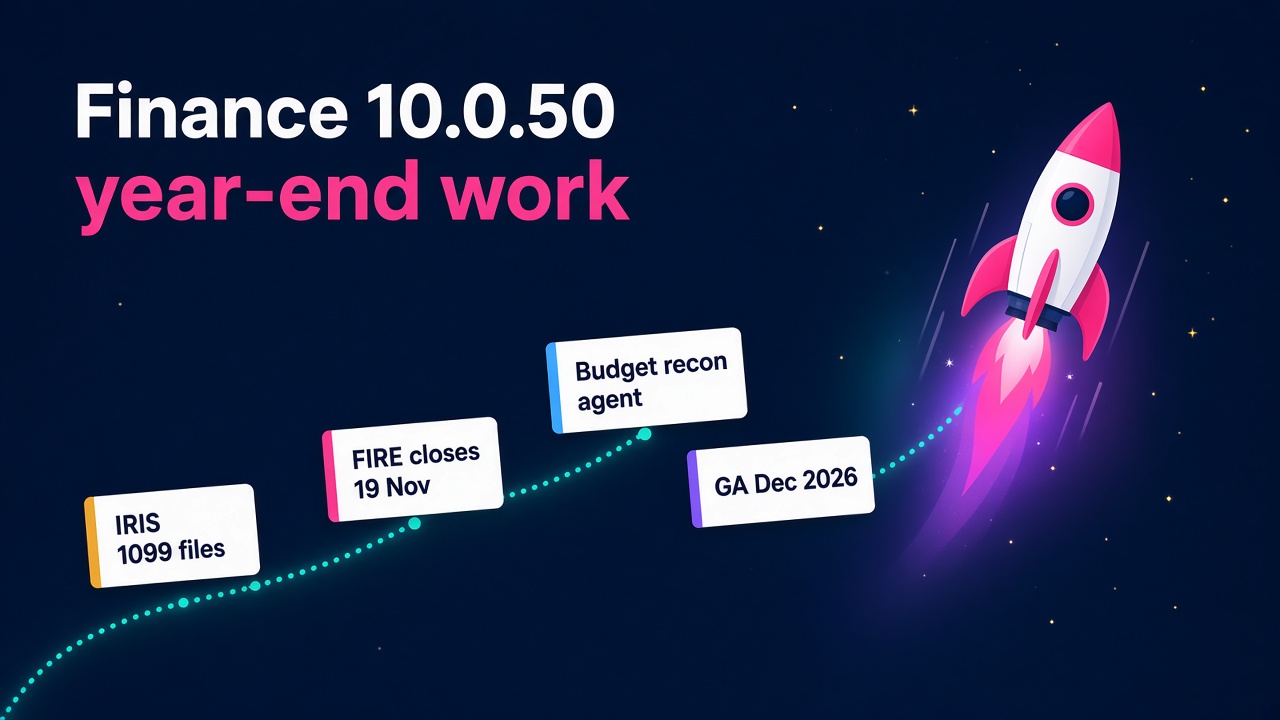
D365 Finance 10.0.50 brings IRS IRIS 1099 files, financial tags and agent budget reconciliation. Here is the year-end work it creates and how to prepare.
Every October, Microsoft quietly drops a preview build of Dynamics 365 Finance, and every October most people skim the release notes, see a short table and move on. This year I'd urge you not to. Version 10.0.50 looks small on paper, but it lands right on top of a hard US tax deadline, a growing appetite for agent-led month-end close, and a December go-live window. That combination creates real, billable work for finance consultants, solution architects and developers between now and February.
Here's what is actually in the release, why it matters, and what I'd do this month if I were working in the Finance and Operations space.
What is in Dynamics 365 Finance 10.0.50?
According to Microsoft's 10.0.50 release notes, the build number is 10.0.2919 and the schedule is:
- Preview: October 2026
- General availability (self-update): December 2026
- General availability (auto-update): January 2027
So customers who self-update will be moving to it before Christmas, and everyone else gets it in the new year whether they planned for it or not. The headline features are:
- IRS IRIS 1099 files. US legal entities can generate IRS-compatible CSV files for Forms 1099-DIV, 1099-G, 1099-INT, 1099-MISC, 1099-NEC, 1099-OID and 1099-S, validate issuer and recipient details, split files by form type and tax year, and upload them manually to the IRS Information Returns Intake System (IRIS) Taxpayer Portal.
- Financial tags for budget register entries. Tags now work on budget register entry headers and lines.
- Financial tags for Subscription billing (preview). Tags can be captured on billing schedule lines and carried through to downstream billing and accounting transactions.
- Budget control reconciliation in the Account reconciliation agent (production-ready preview). Budget control amounts on source documents are compared with what was posted to the general ledger, and every difference becomes an exception to investigate.
- Tax and globalisation updates. Sweden VAT exchange rates based on the VAT register date, tax exempt numbers on sales prepayment invoices, LATAM globalisation for Argentina (preview), and several Tax calculation previews including tax rate import through Electronic reporting configurations and automatic tax feature version updates.
The platform update notes for 10.0.50 also matter for developers. X++ client and server keyword warnings are now compilation errors, and there are new checks such as IndexCannotContainVirtualField and FormControlNotFound. If you look after a big customisation estate, that's a build that might fail on day one.
Why is the 1099 feature such a big deal right now?
Because the IRS is switching off its old system this month.
The IRS has confirmed that its Filing Information Returns Electronically (FIRE) system is being retired. The key dates are:
- 9 November 2026: last day to make changes to FIRE Transmitter Control Code (TCC) applications.
- 19 November 2026, 3pm US Eastern: last day to file information returns through FIRE.
- From 1 January 2027: IRIS is the only electronic filing system for information returns, including prior-year returns and corrections.
The IRS reminder explains that the IRIS Taxpayer Portal is free, takes up to 100 returns per submission, and accepts manual entry or a CSV upload. Larger volumes go through IRIS Application to Application, which uses XML and needs compatible software. Existing FIRE TCCs don't carry across, so every filer needs a new IRIS Application for TCC. US accounting firm Cavanaugh & Co. suggests allowing up to 45 business days for that application, which is why they call October and November the time to act.
Put that next to the 10.0.50 timeline and you can see the opportunity. Every US entity running Dynamics 365 Finance needs a 1099 plan for the 2027 filing season. Some will go with the new CSV export and the portal. Some, with thousands of vendors, will need to think about A2A or a third-party filing tool. All of them need someone who understands vendor 1099 setup, data quality and the cutover. That's a finance consultant's dream brief: clear deadline, clear value, and a client who can't put it off.
What does budget control reconciliation tell us about where AI is going?
The Account reconciliation agent has been in public preview since April 2025, according to the archived release plan, which also sets out Microsoft's aim to evolve it from "guided automation" into "a fully autonomous reconciliation orchestrator". In 10.0.50 it gets budget to general ledger reconciliation, which only applies when Budget control and Posting definitions are enabled.
On its own, that's a useful feature for public sector, education and any organisation that runs tight budget control. As a signal, it's much bigger. In its agentic ERP update from 23 September, Microsoft said the agent is evolving to resolve exceptions in bulk, scoped by legal entity and module, with limits and notifications. The same post describes re-engineered financial journals, AI invoice capture in accounts payable, and Finance Agent skills for reconciliation, variance analysis and collections across Copilot, Excel, Outlook and Teams.
I'm genuinely excited about this. Month-end close has always been where good finance people burn their evenings matching numbers. Handing the matching to an agent, and keeping people for the judgement calls, is exactly the right split. But it doesn't run itself. Someone has to set up Budget control and Posting definitions properly, decide which modules and legal entities the agent works on, set the limits, and design who approves what. That's consulting work, and it pays.
A word of realism. Consultants at Logan Consulting point out that the agent is a production-ready preview that currently needs Microsoft-assisted activation, and that AI content and UI are currently US English. Check the current activation process in your tenant before you promise a client a date.
Why do financial tags keep showing up?
Financial tags have been creeping across Dynamics 365 Finance for a few releases, and 10.0.50 extends them to budget register entries and, in preview, Subscription billing. That matters because tags let finance teams capture extra reporting context without adding more financial dimensions to the chart of accounts.
For consultants, the practical point is this: if a client is already using tags in the general ledger, the budget and subscription billing extensions let them report budget against actuals, or recurring revenue by contract type, using the same context. That's a nice, contained piece of design work, and it suits anyone who enjoys the reporting side of finance.
Who gets the work from 10.0.50?
Here's how I see demand landing over the next three to four months.
Finance functional consultants
The 1099 work is the obvious win for anyone with US accounts payable experience. Add budget control reconciliation and financial tags, and you have a solid story for any client conversation this quarter. If you have hands-on budgeting and budget control experience in Dynamics 365 Finance, put it front and centre, because it is a specialist skill and clients will ask for proof of it.
Solution architects
The interesting design questions are around agents: which reconciliations to hand over first, how to scope by legal entity, what approval looks like, and how this fits with the Dynamics 365 ERP MCP server and Copilot. Clients will want someone who can draw that picture on one page.
X++ developers
The compiler changes are small but real. Teams with large customisations need to build against 10.0.50 in a sandbox early, fix anything the new errors catch, and do it before the December self-update window, not during it.
Tax and globalisation specialists
Sweden, Argentina and the Tax calculation previews add steady work for globalisation specialists, and they sit alongside the e-invoicing mandates already keeping this group busy.
Test and release managers
Every service update needs regression testing, and this one arrives in the middle of year-end. Anyone who can run a tidy test cycle with good automation is worth their weight in gold right now.
How do you get ready this month?
Here's a practical list you can start on this week.
- Read the release notes properly. The 10.0.50 page is short. Read every row and note which ones touch your clients.
- Spin up a sandbox on 10.0.50. Turn on the IRIS 1099 feature in Feature management and generate a test CSV with dummy vendors. Being able to say "I've done it" beats having read about it.
- Learn the IRIS basics. Read the IRS IRIS guidance, understand the 100 returns per submission limit on the portal, and know when A2A makes more sense.
- Check every US client's TCC status. A short, friendly email asking whether they have an IRIS TCC could be the most valuable thing you send this month.
- Try budget control reconciliation. Set up Budget control and Posting definitions in a demo environment, run the reconciliation and work through a few exceptions. Write up what you learn.
- Practise with an AI assistant. Use a general tool like Grok Bot, Claude or ChatGPT to draft a client briefing on FIRE to IRIS, then check every fact against the IRS pages. It's a quick way to sharpen your explanation, as long as you verify everything.
- Compile early. Developers, build your models against 10.0.50 now and log every new error.
- Update your profile. Add "IRIS 1099", "Account reconciliation agent" and "financial tags" to your CV and your consultant profile once you have hands-on time. Recruiters search for exactly these phrases.
The bigger picture
Microsoft has moved away from release waves to an always-on roadmap, so updates like this are going to keep arriving in smaller, steadier pieces. That suits people who learn a little every week. It makes things harder for anyone who waits for a big annual moment to catch up.
10.0.50 is a nice example of where Dynamics 365 Finance is heading. The compliance work is still there and still important, but more of the routine matching and checking is moving to agents, while people move up to design, governance and judgement. That's a better job, not a smaller one. Finance consultants who learn to set up and supervise these agents now will be the ones clients ask for by name in 2027.
What to do next
- Browse the latest Dynamics 365 Finance jobs and look for roles that mention year-end, 1099 or close automation.
- Compare your rate or salary on the D365 salaries page.
- If you're hiring for year-end or 10.0.50 work, post a role on the employers page.
- Explore finance add-ons and tax tools on the products and vendors pages.
- Make your consultant profile visible so the right projects can find you.
Pick one item from the list above and do it before Friday. The 19 November FIRE deadline won't move, and neither will the December update window.