E-Invoicing Mandates: The D365 Work Wave for 2026 and 2027
Belgium, France, Germany and the UK are making e-invoicing compulsory. Here's what D365 already supports and the skills consultants need now.
If you've been in finance systems for a while, you'll remember when "compliance work" meant a VAT return tweak and a new report layout once a year. Those days are gone. Across Europe, and soon the UK, governments are making structured electronic invoicing compulsory, and every one of those mandates lands squarely on the ERP. For Dynamics 365 people, that's a lot of good, well-funded work arriving on a fixed timetable.
The timing is worth noting. On 16 October Microsoft updated its Business Central roadmap with a batch of compliance features, including French e-invoicing and e-reporting, payments in the E-Document framework, self-billed invoices, and new payment practice reporting for Australia and the UK. Meanwhile France's mandate went live in September and Germany's next step is only a couple of months away.
I'm genuinely optimistic about this one. Mandates are the rare kind of project a CFO can't push to next year, and they force clients to fix the data and processes that make everything else, including AI agents, work better.
What is actually changing, and when?
Here's the short version of the deadlines that matter most for D365 customers, taken from the Lasernet guide to 2026 and 2027 mandates:
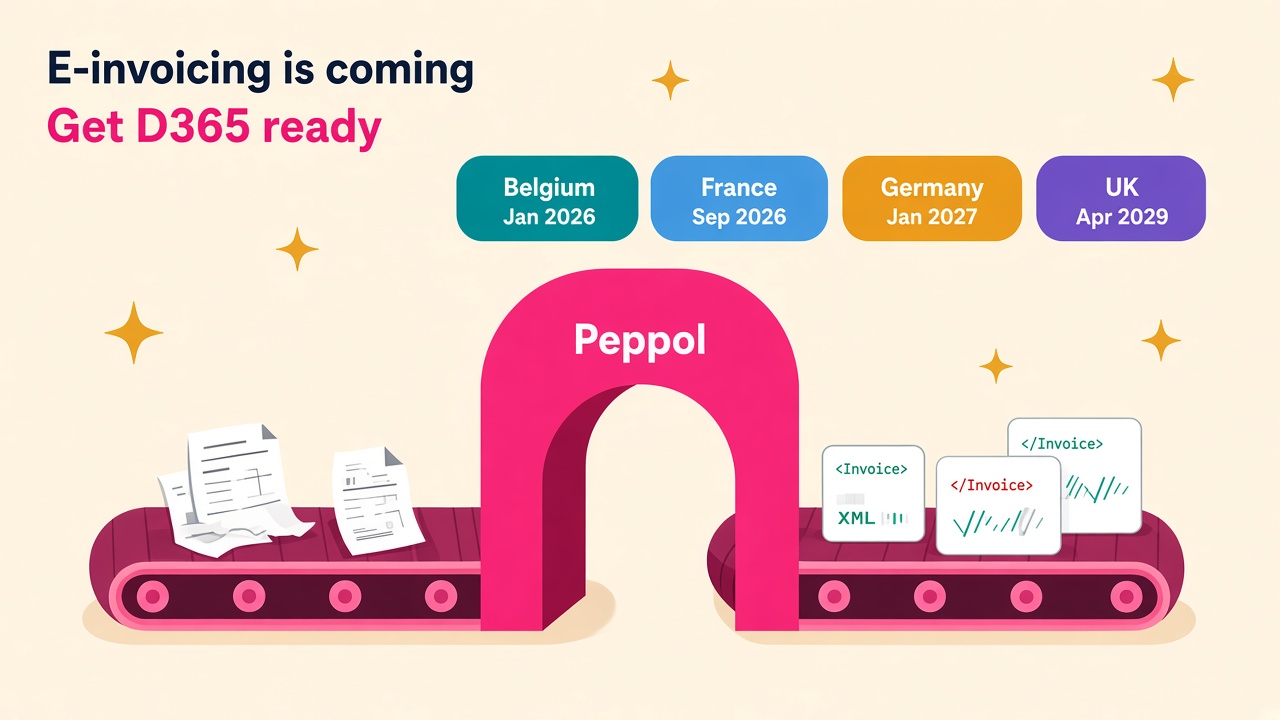
- Belgium, 1 January 2026. All VAT-paying Belgian businesses must exchange structured B2B e-invoices over the Peppol network, using Peppol BIS Billing 3.0 through a certified access point.
- Croatia, 1 January 2026. Fiscalisation 2.0 brought in mandatory B2B e-invoicing, with invoices fiscalised through the tax administration as well as exchanged.
- Poland, 1 February 2026. Large taxpayers had to start issuing invoices through KSeF, the national platform, with most other VAT-registered businesses following from 1 April 2026 and micro businesses from 1 January 2027.
- France, 1 September 2026. Every company must now be able to receive e-invoices, and large and mid-sized companies must issue them. SMEs and micro businesses start issuing from 1 September 2027. Invoices go through a certified platform (a PDP) and lifecycle statuses such as rejection, acceptance and payment have to be managed.
- Greece, 1 October 2026. The remaining businesses joined the large companies that started in March.
- Germany, 1 January 2027. Businesses with turnover above €800,000 must issue structured e-invoices aligned with EN 16931, mainly XRechnung or ZUGFeRD.
- Spain, 2027 onwards. Larger businesses must comply 12 months after the technical Ministerial Order, with everyone else following 12 months later, plus mandatory reporting of invoice status within four days.
- United Kingdom, 1 April 2029. The government has confirmed mandatory e-invoicing for all VAT invoices between VAT-registered businesses, and has named Peppol as the core network.
Australia and New Zealand don't have a legal B2B mandate, but Microsoft already supports the Peppol PINT A-NZ format in Business Central and is clear that companies are encouraged to use it (Microsoft Learn FAQ).
The pattern is obvious. Peppol is becoming the default plumbing, and the UK has joined that club. If you work with UK clients, 2029 sounds a long way off until you remember how long it takes a mid-sized business to clean up its customer master data.
What does Dynamics 365 already do?
Quite a lot, which is good news for consultants, because the work is configuration, data and process rather than heroic custom code.
Business Central
Business Central handles e-invoicing through its E-Documents framework. Microsoft lists support for Peppol BIS 3 and XRechnung (UBL) and ZUGFeRD in Germany, Peppol BIS 3 and OIOUBL in Denmark, Peppol in Norway, Factura-E in Spain, and Peppol PINT A-NZ in Australia and New Zealand.
The October roadmap updates add a few important pieces:
- France e-invoicing and e-reporting (RM576832). Business Central follows the French five-corner model. Microsoft isn't a certified PDP itself, so customers connect through E-Document connectors to certified providers. It supports Peppol BIS3 and Factur-X, sends and receives invoices with all mandatory lifecycle statuses, and produces the transaction e-reporting France wants monthly or quarterly.
- Payments with the E-Document framework (RM576813). You can mark an e-document as fully paid, partially paid or unpaid and pass that through the access point, including payment date, amount and VAT. Some countries require exactly this.
- Self-billed invoices (RM576881). A new vendor setting lets buyers raise invoices on a supplier's behalf under a self-billing agreement, with its own number series and layout. Those vendors are blocked from inbound e-documents so you don't get duplicates.
- Australian Payment Times Reporting (RM576802). Companies with more than AUD 100 million turnover must report every six months on how they pay small business suppliers. Business Central now groups the data and produces the report in the required format.
- UK payment practices (RM576839). The UK localisation now covers the 2024 amendment regulations, adding total value of payments, late payments against agreed terms and the share of late payments caused by disputes, with a dispute flag on purchase invoices.
Finance and operations apps
On the enterprise side, D365 Finance uses Electronic Invoicing and Microsoft keeps a country-by-country coverage table on Microsoft Learn. It includes Peppol invoices for Belgium via a third-party connection to Edicom, French B2B invoices through Edicom acting as a certified platform, xRechnung for Germany, and Australia's Peppol extension, among many others.
So the product side is broadly there. What clients are missing is people who can make it work in their environment.
Why is this good news for D365 careers?
It's work with a hard deadline
Most ERP projects have a business case that can be argued with. A legal mandate can't. If a German client above the threshold isn't issuing compliant invoices in January, that's a problem the CFO owns personally. Deadlines like that unlock budget, and they tend to bring forward other work too.
It's mostly functional and data work
Getting e-invoicing right is less about XML and more about the boring stuff that functional consultants are good at. Are VAT registration numbers on every customer? Do item and unit of measure codes map to the standard? Who handles a rejected invoice in France, and how quickly? What happens to credit notes, prepayments and self-billing? That's process design, testing and master data clean-up.
It lays the groundwork for agents
This is the part I find most exciting. Structured invoices are far easier for software to read than scanned PDFs. Once suppliers send proper e-invoices, tools like the Business Central Payables Agent and similar automation in D365 Finance have cleaner data to work with. Every e-invoicing project is quietly making the client's finance team ready for the agent era.
Multi-country clients need help most
A group with entities in Belgium, France, Germany and Poland has four different rule books, four go-live dates and a mix of Peppol, platform and clearance models. People who understand more than one country's requirements, or who have done a rollout across several, are going to be very busy.
Which skills should you build?
Here's what I'd focus on if I wanted to be the person partners call for this work:
- Peppol fundamentals. Understand the four-corner model, access points, participant IDs and BIS Billing 3.0. It's the common thread across Belgium, Australia, New Zealand, and soon the UK.
- The E-Documents framework in Business Central. Set up an E-Document Service, configure a format, connect to a provider and process an inbound document in a sandbox.
- Electronic Invoicing in D365 Finance. Know how features are imported, configured and connected to third-party services.
- One country in real depth. France and Germany are the obvious picks right now. Learn the formats, the statuses, the deadlines and the gotchas.
- Master data clean-up. Being able to run a quick data quality check on customers and vendors, and fix it, is worth a lot on these projects.
- Testing and exception handling. French rules count an invoice rejected in transit as failed, so rejection, retry and support processes matter as much as the happy path.
- Payment reporting. If you work in Australia or the UK, the new payment practice features are a nice, contained piece of work to get your hands on.
What will clients and partners ask you?
Expect questions like these in interviews and pre-sales meetings:
- Which countries is the client trading in, and which mandates apply to each entity?
- Are we going direct through Microsoft's connectors, or through an ISV or access point provider?
- How will inbound e-invoices be received and matched, not just outbound ones sent?
- What's the plan for rejected invoices and lifecycle statuses?
- How clean is our customer and vendor data, and who owns fixing it?
If you can answer those calmly, with a rough plan, you're already ahead of most candidates.
What should employers and partners do now?
If you're a D365 partner or an in-house team, a few practical steps:
- Audit every legal entity against the deadlines above and put the dates in a single plan.
- Check which ISV add-ons you rely on for e-invoicing and confirm their roadmap for France, Germany and the UK. Our products and vendors directories are a good place to compare options.
- Start customer and vendor data clean-up now. It always takes longer than expected.
- Hire or train ahead of demand. People with real e-invoicing delivery experience will be scarce in late 2026 and through 2027, and you can find them on our consultants directory.
- Talk about it openly on your employer profile. Candidates like knowing they'll get compliance experience that travels.
The bigger picture
E-invoicing can sound dry, but I think it's one of the most useful shifts happening in finance systems. Paper and PDF invoices are being replaced by clean, structured data flowing between businesses and tax authorities, and that makes finance faster, more accurate and much better suited to automation. For D365 consultants, it's steady, well-paid work with clear deadlines and a direct line into the agent projects that come next.
What to do next
- Browse live D365 Finance and Business Central roles on our jobs board.
- See what finance and compliance specialists earn on the salaries page.
- Add any Peppol, E-Documents or Electronic Invoicing experience to your consultant profile, and name the countries you've delivered.
- Hiring for e-invoicing projects? Tell candidates about it on the employers page.