Supplier Engagement in D365 SCM: New Work for Procurement Pros
Microsoft's Supplier Engagement and Procurement Agent updates are reshaping D365 SCM. Here's what they do, who needs the skills and how to get ready now.
If you work in Dynamics 365 Supply Chain Management, the most interesting news this month isn't a shiny new Copilot button. It's the slow, sensible plumbing Microsoft is laying under procurement, and it's going to create a lot of good work for people who understand both how buyers actually operate and how Power Platform hangs together.
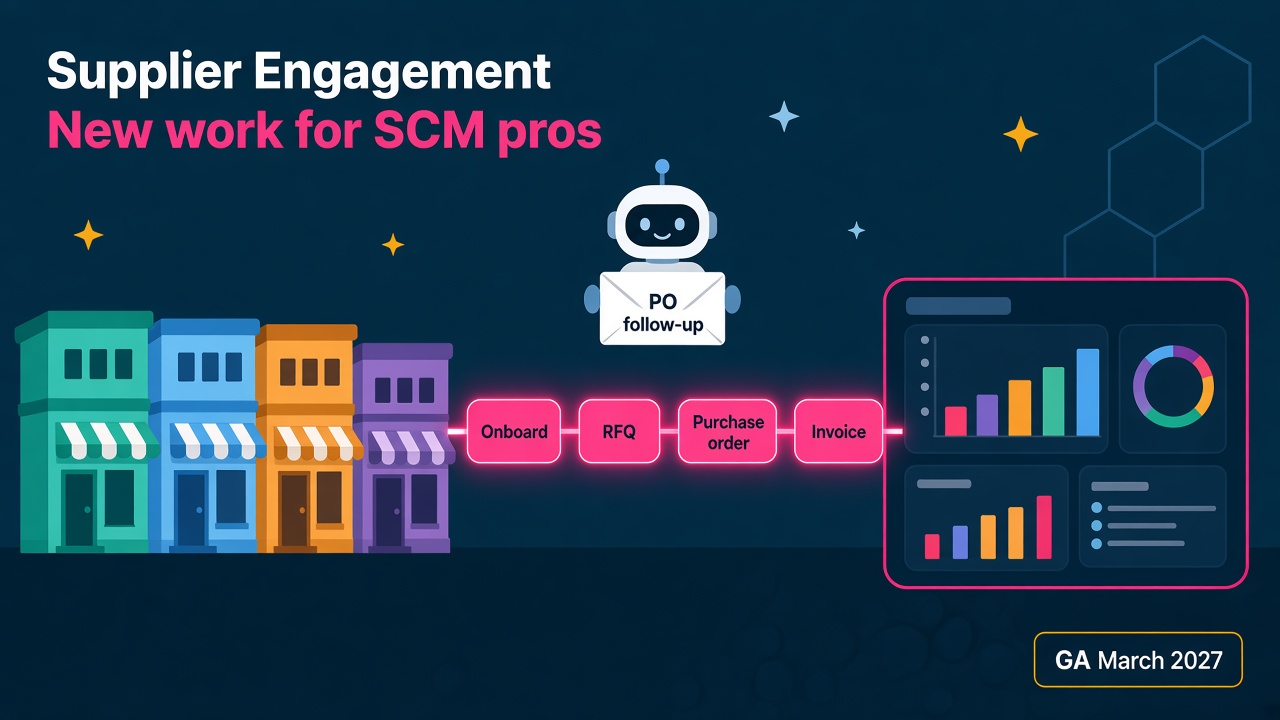
Supplier Engagement for D365 Supply Chain Management went into public preview on 27 July 2026, according to Microsoft Learn, with general availability planned for March 2027. Microsoft announced it on its Dynamics 365 blog in August, and it's back in the headlines this week, with ERP News framing it on 26 October as the groundwork for agent-driven procurement. Add a couple of Procurement Agent updates heading for general availability in December, and you have a clear signal about where SCM projects are going over the next 18 months.
I'm optimistic about this one. Here's why, and what I'd do about it if I were a D365 SCM consultant right now.
What is Supplier Engagement, in plain English?
It's a proper front door for your suppliers, sitting on Power Platform and plugged into D365 SCM and Finance.
There are two halves to it. Inside the business, buyers and supplier relationship managers get a Power Apps workspace where they can register prospective suppliers, run structured onboarding, check qualifications, manage approvals, keep certifications and capabilities up to date, schedule supplier reviews and track performance across every legal entity from one place.
Outside the business, suppliers get a portal built on Power Pages. They can register themselves, maintain their own details, respond to requests for quotation (including managed bidding), confirm purchase orders and submit invoices. Microsoft says it works alongside the existing vendor collaboration features rather than ripping them out.
The bit I like most is global vendor management. You keep one shared supplier profile, with contacts, addresses, certifications and capabilities, and once a supplier is qualified and approved you release it into one or more legal entities for the actual transactions. Anyone who has cleaned up a vendor master with the same supplier entered five different ways across five companies knows exactly how valuable that is.
D365 SCM stays the system of record for operational procurement. Supplier Engagement uses Dataverse, Power Apps and Power Pages, event-driven synchronisation, configurable mappings and virtual entities, so operational data can be shown without copying everything into Dataverse.
Why does this matter for AI agents?
Because agents are only as good as the context they can see and the rules they have to respect.
Microsoft has been fairly direct about this. For an agent to chase a late purchase order or prepare an RFQ response, it needs to know the supplier relationship, where the process is up to, and what permissions, approvals and policies apply. Today, a lot of that lives in email threads, spreadsheets and somebody's memory. Supplier Engagement drags it into one governed place, which is exactly what an agent needs before you can trust it with anything real.
You can already see the agent side moving. Two Procurement Agent items appeared on the roadmap this month, both with general availability targeted for December 2026:
- Custom follow-up criteria (RM573704, published 9 October). Buyers will be able to extend the rules that decide which purchase order lines need a supplier follow-up, using standard, extended and custom tables, with table joins and fields from those tables as filters.
- Custom follow-up scenarios (RM573705, published 13 October). Buyers get a setup page to create their own scenarios, each with a name, the instructions that shape the email the agent writes, and the business entity it applies to. The agent then writes and sends messages according to that scenario, and the configuration history keeps the scenario details so the audit trail still makes sense later.
On top of that, Microsoft launched a preview of the Copilot Cowork plugin for finance and operations apps on 16 October, aimed at orchestrating insights and actions across ERP data, email, documents and spreadsheets with humans kept in the loop. The preview scope is limited, but the direction is obvious.
Put those together and the picture is simple enough. The supplier data gets cleaned up and centralised, the agents get configurable rules written by buyers rather than developers, and Copilot sits over the top. Someone has to design, build, test and govern all of that, and that's you.
Where is the new work for consultants?
Procurement process design comes back into fashion
For years, supplier onboarding has been a bit of an afterthought on SCM projects. It was often handled with a form, an inbox and a long-suffering AP clerk. Supplier Engagement makes it a proper workstream with registration, qualification, approval and release into legal entities.
Clients will need someone who can sit with the procurement team and map who approves what, which certifications matter in which countries, and what "qualified" actually means for their business. That's classic functional consulting, and it pays well when you do it properly.
Power Platform skills become non-negotiable for SCM people
This is a Dataverse and Power Pages product with an SCM back end. If you're an SCM functional consultant who has never opened the Power Apps maker portal, now is a very good time to start. I wrote about this more broadly in why every D365 consultant needs Power Platform skills, and Supplier Engagement is about as clear an example as you'll find.
Writing rules for agents is a new consulting skill
The Procurement Agent updates let buyers define their own follow-up criteria and email scenarios. In practice, buyers will want help. Someone needs to work out which purchase order lines deserve a chase, what tone a follow-up email should take with a strategic supplier compared with a one-off vendor, and how to test that the agent behaves before it emails 400 suppliers on a Monday morning.
That's part process design, part data knowledge and part common sense. It's also a skill very few people can show on their CV yet.
Vendor master clean-ups get a business case
Global vendor management gives finance and procurement a reason to finally fix duplicate supplier records across entities. Data migration and master data people should be pitching this now, before GA, while clients are planning.
What do you actually need to know to get started?
The deployment overview on Microsoft Learn is worth reading end to end. A few things stood out to me:
- You need D365 SCM version 10.0.48 (build 10.0.2645.52) or later, and the environment must be connected to Dataverse.
- The finance and operations virtual entity solutions must be installed, and the Finance and Operations Virtual Entity app needs to be version 2.20.3385.8 or later.
- In the preview, the app is only available in US English. Dataverse base language can't be changed after provisioning, so Microsoft recommends testing on an environment created with US English as its base language. Other languages are promised for GA.
- Installation needs a dedicated Microsoft Entra ID service account. It must be a standard user account, not an app registration, with System Administrator in Dataverse and SCM plus the Power Platform administrator role.
- Licensing is still under review. The supplier portal has a 30-day trial, and Microsoft says licensing details will be published before GA.
That language point is a real gotcha for clients in Europe, Latin America and Asia, so raise it early. And be honest with clients about licensing: nobody can quote them a final cost yet, so pilots should be scoped as learning exercises, not committed rollouts.
One more housekeeping note. Microsoft stopped publishing the traditional release plans in September 2026 and moved new Dynamics 365 and Power Platform capabilities to the AI at Work roadmap. If you're still waiting for the old wave PDF, it isn't coming. I covered how to keep up in D365 release waves are over.
Is the job market showing it yet?
SCM hiring is steady and global. On D365 Market's jobs board this month there are eight live roles with "Supply Chain" in the title, posted between 5 and 26 October. They include a Senior D365 F&O Supply Chain Management Consultant at BDO in Calgary, a Senior SCM Functional Consultant at BDO USA in Ohio, a D365 Manufacturing and Supply Chain Lead at Noumi in Sydney, a D365 Functional Consultant for Operations and Supply Chain at Morgan Advanced Materials in Germany, and even a supply chain digitalisation internship at KPMG in Milan.
None of those ads mention Supplier Engagement by name yet, and I wouldn't expect them to while it's in preview. But the candidates who can talk confidently about it in interviews over the next six months will stand out. Partners will be looking for people to run their first pilots, and the first pilots are where reputations get made.
For a sense of what SCM people are earning, have a look at our D365 salary guide.
What I'd do this month if I were an SCM consultant
- Spin up a sandbox. Get a trial or partner environment on 10.0.48 or later, connected to Dataverse with a US English base language, and install the preview. Nothing beats having clicked through it yourself.
- Run the supplier journey end to end. Register a test supplier through the portal, qualify and approve it, release it into two legal entities, send it an RFQ, confirm a PO and submit an invoice. Write down every place it surprised you.
- Learn enough Power Pages to be dangerous. You don't need to become a web developer, but you should understand how the portal is configured and secured.
- Draft three Procurement Agent scenarios for a real client. For example, a polite nudge for a late confirmation, a firmer chase for an overdue delivery on a critical item, and a check-in on missing certification documents. When the December GA lands, you'll have something ready to show.
- Tidy up your profile. Add Supplier Engagement, Power Platform and Procurement Agent experience to your consultant profile as soon as you have hands-on time, and be specific about what you built.
- Talk to your clients' procurement leads, not just IT. They are the people who feel the pain of duplicate vendors and supplier email chaos, and they'll champion the business case.
If you're on the vendor side, it's also worth watching the products and vendors directories. Plenty of ISVs already sell supplier portals and procurement add-ons, and Microsoft moving into this space will change how they position themselves.
The bigger picture
I've watched a lot of ERP features arrive with a bang and fade quietly. This one feels different because it's boring in the right way. Clean supplier data, a decent supplier portal and governed processes are the foundations every agent needs. Once they're in place, the agents on top get dramatically more useful, and procurement teams get to spend their time on supplier relationships rather than chasing PO confirmations by email.
For consultants, that means more interesting projects and a fresh reason for clients to invest in SCM. I think it's a great time to be in supply chain on Dynamics 365.
What to do next
- Browse live D365 Supply Chain and F&O jobs and see who is hiring.
- Check current pay on the salaries page.
- Create or update your profile in the consultant directory so partners can find you.
- If you're hiring SCM talent, list your roles on the employers page.