D365 CRM Skills in Copilot: What CRM Consultants Do Next
Microsoft put 30 Dynamics 365 CRM skills into Copilot and launched a Sales Development Agent. What it means for D365 CRM consultants and how to get ready.
For most of its life, the CRM has been a place people had to go. Sellers left Outlook, opened Dynamics 365 Sales, hunted for the right opportunity, updated three fields and went back to their inbox. A good chunk of every CRM project I have seen was spent persuading people to do exactly that, and a good chunk of every CRM failure came from them quietly not bothering.
On 8 October Microsoft took a big swing at that problem. It announced 30 new pre-built CRM skills for Copilot Cowork, now generally available, plus Dynamics 365 CRM in the flow of Teams and the Sales Development Agent, both in public preview. The idea is simple: bring the CRM to where people already work, rather than dragging people to the CRM.
If you are a Dynamics 365 Sales, Customer Service or Customer Insights consultant, this changes what your next few projects will look like. In a good way.
What did Microsoft actually announce?
There are three pieces, and they are worth separating because they are at different stages.
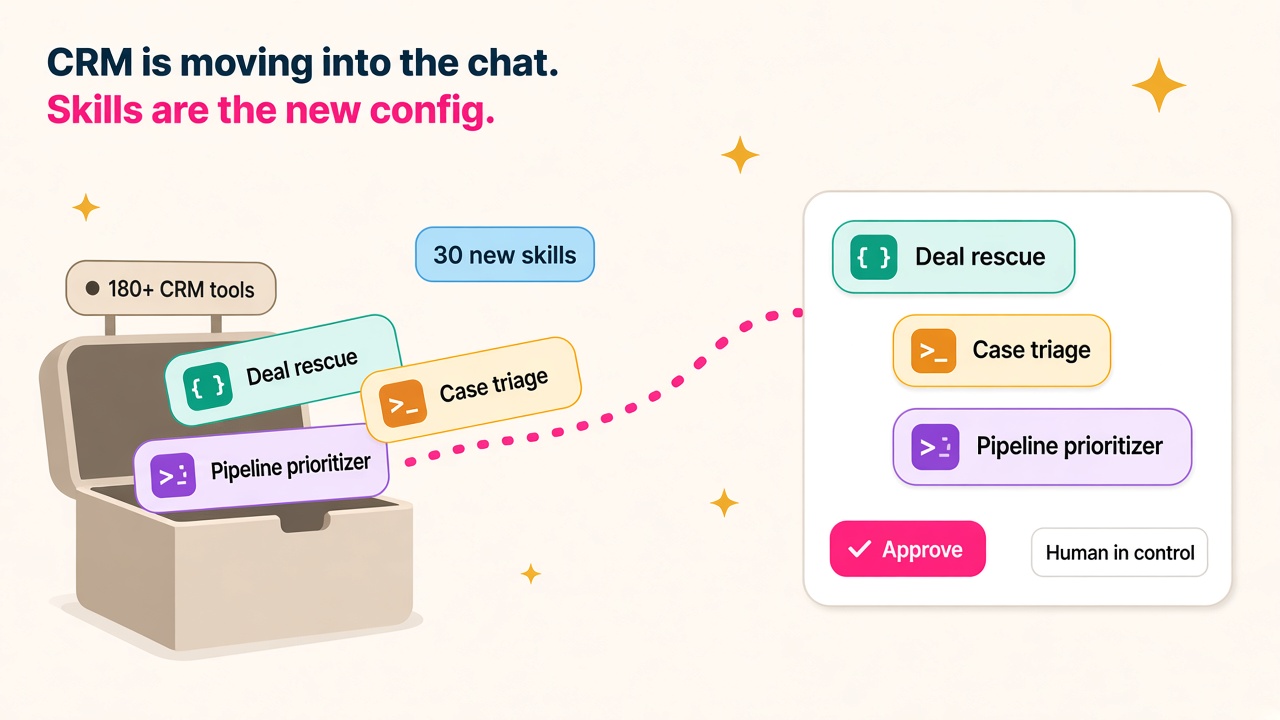
30 CRM skills for Copilot
The headline is 30 pre-built skills for Copilot Cowork, generally available now. According to Microsoft, they work with more than 180 generally available tools across Dynamics 365 Sales, Customer Service and Customer Insights. The same skills are available in Code through the Frontier programme, and in Autopilot, which is in private preview.
Microsoft gives a handful of examples, and they are refreshingly practical:
- Sales: pipeline prioritizer, deal rescue for stalled opportunities, a customer engagement strategy that recommends a 30-day account plan, competitive strategy, business case composer and deal desk.
- Service: case triage, answer research from verified knowledge and similar cases, and draft customer reply grounded in customer data.
- Across both: customer brief and value metrics, reconcile my opportunity, and stage advance readiness.
Organisations switch them on from the customisation area of the Copilot experience, connect accounts and pick a Dynamics 365 environment. The plugins respect existing Dynamics 365 and Microsoft 365 permissions.
Dynamics 365 CRM in the flow of Teams
The second piece connects a Teams channel to a customer account, so pre-meeting briefs, case notifications and account updates turn up in the channel where the team is already talking. The Microsoft 365 message centre notice MC1492151 says it is in public preview from 8 October, needs licences for Microsoft 365 Copilot, Dynamics 365 Customer Service and Teams, and needs an administrator to activate the Channel Agent.
Sales Development Agent
The third piece is the most autonomous. The Sales Development Agent researches prospects, personalises outreach, manages follow-up conversations and qualifies leads before handing them to a seller. It is managed in Teams and sends email from its own Exchange account. It is in public preview, Frontier enablement is required until 16 November, and from 16 November 2026 it will be billed through Copilot Credits.
Microsoft quotes Adobe's sales strategy team saying that in three weeks from a limited launch, the agent drove meetings with more than 10 customers they would not otherwise have reached. That is one customer's early result, not a benchmark, but it is the kind of number that gets a sales director's attention.
What is the difference between a tool and a skill?
This is the part I would make sure you can explain clearly, because clients are going to ask.
Microsoft describes three layers. Dynamics 365 holds the data and business logic. MCP (Model Context Protocol) tools expose that data and approved actions to AI experiences in a standard way. Skills sit on top and give task-specific guidance: which evidence to look at, how to handle uncertainty and what a useful answer should contain.
Microsoft's own example is a good one. Retrieving an opportunity record is a tool action. Working out why a deal has stalled needs a skill that interprets the context and structures a recommendation.
Here is my take. For twenty years, CRM consultants have earned their keep through configuration: entities, forms, business process flows, plug-ins and security roles. All of that still matters, because the skills sit on top of it. But a growing share of the value is moving into the layer that tells AI how your client sells and serves. What does "at risk" mean for this business? What evidence moves a deal from Propose to Close? What tone does a customer reply need? That is process knowledge, and it is the stuff good functional consultants already carry around in their heads.
Why is this good news for D365 people?
Adoption stops being the bottleneck
The oldest complaint about CRM is that the data is rubbish because nobody updates it. A skill like reconcile my opportunity compares customer interactions with the opportunity record and proposes field-level updates. If sellers can approve those updates from Copilot or Teams, data quality goes up without anyone being nagged. Better data makes every report, forecast and agent more useful, which makes the whole platform stickier. That is good for anyone whose career is built on it.
The work moves up the value chain
Less time building forms that nobody opens. More time designing how a business wants its pipeline judged, its cases triaged and its customers spoken to. Those conversations happen with sales directors and service heads, not just IT, and they are worth more.
Microsoft is shipping this fast
This is not a lone announcement. The October Partner Center announcements list Sales and Service skills, the Sales Development Agent, a Service Agent for Microsoft 365 apps, Agent Accounts in Copilot Studio (private preview from 15 October) and Microsoft Contact Center Intelligence, all inside one month. When a vendor moves this quickly, partners need people who understand it, and customers need someone internal who can own it.
What are the realistic caveats?
I am an optimist, but I would rather you heard these from me than from a client.
- Most of it is preview. Cowork skills are generally available. Code is Frontier, Autopilot is private preview, CRM in Teams and the Sales Development Agent are public preview. Be precise about which is which.
- Licensing is layered. Microsoft 365 Copilot, Dynamics 365 licences, Teams and, for the Sales Development Agent, Copilot Credits from 16 November. Someone has to model the cost before a client gets a surprise bill, and that someone could be you.
- Autonomous outreach needs guardrails. An agent sending email from its own mailbox is a brand and compliance question as much as a technical one. Who reviews templates? What happens when a prospect replies with a complaint?
- People stay in control, by design. Microsoft is explicit that a proposed update should not appear as a saved change and a draft should not appear as a sent message. Testing that properly is real work, and it belongs in your test plans.
None of this is a reason to wait. It is a reason to learn it properly now.
Which roles will grow?
Looking at how these pieces fit together, here is where I would expect demand:
- CRM functional consultants who can write skills-ready process definitions, such as stage criteria, risk signals and triage rules, clearly enough for an AI to follow.
- Copilot Studio and agent builders who can extend the skills into custom agents for a client's own workflows.
- Dataverse and security specialists, because skills only see what permissions allow. Messy security roles become very visible very quickly.
- Licensing and commercial advisers who can explain Copilot Credits and seat licences in plain English.
- Sales operations people with D365 experience, who understand what a sales development rep actually does all day and can set the Sales Development Agent up to do it well.
- Adoption and change leads, because sellers working alongside an agent is a new habit for most teams.
You can see which of these skills are already turning up in ads on the D365 jobs board, and check where Sales and Customer Service pay sits on the salaries page.
How can you get ready this month?
Most of this you can start this weekend.
Read the source material
- Read the 30 CRM skills announcement end to end, especially the section on keeping people in control.
- Read the Copilot blog post on CRM in the flow of work, and the Sales Development Agent activation guide on Microsoft Learn, so you know the prerequisites cold.
Try it in a sandbox
- If you have access to a tenant with Copilot, switch on the Sales or Customer Service skills and run them against demo data. Ask deal rescue about a stalled opportunity and see what evidence it uses.
- Then deliberately break things. Give it an opportunity with missing data and see how it handles uncertainty. That tells you what a client needs to fix before go-live.
Write down how one business sells
Pick a client or employer you know well and write a single page that defines a healthy deal, an at-risk deal and the evidence needed to move between stages. That page is the raw material every one of these skills needs, and being able to produce it quickly is a very sellable skill.
Put an agent on your own learning
If you already use an AI agent, such as Grok Bot, Claude or ChatGPT, ask it to check the Dynamics 365 blog and Microsoft Learn release notes each week and send you a short summary of anything new in Sales, Customer Service and Copilot. It is a no-brainer, and it keeps you current without eating your evenings.
Tell people
Once you have genuinely tried it, add CRM skills, Copilot and the Sales Development Agent to your CV and LinkedIn. If you are independent, list that experience in the consultants directory so partners and customers planning pilots can find you.
What should employers and partners do?
- Look at your CRM customers already licensed for Microsoft 365 Copilot. They are your quickest skills pilots.
- Build a fixed-scope offer around one workflow, such as pipeline review or case triage, with clear success measures like time saved or data completeness.
- Get your licensing story straight before November, when Sales Development Agent billing moves to Copilot Credits.
- Hire for the blend of CRM process knowledge, Copilot Studio and Dataverse security rather than holding out for a perfect match. The employers page has more on finding D365 talent.
- Watch the products and vendors in the ecosystem. ISVs will build their own skills on the same MCP foundation.
What to do next
- Read the 30 CRM skills announcement and the Sales Development Agent guide this week.
- Run two or three skills against demo data and note where data quality lets them down.
- Write a one-page definition of how one business judges its deals.
- Update your CV and LinkedIn once you have hands-on experience to talk about.
- Browse D365 jobs for Sales, Customer Service and Copilot roles, and compare your rate on the salaries page.
The CRM is finally going to where the work happens. The people who know how that work should be done are going to be very busy.