D365 Partner Specialisations Now Count Active Users
Microsoft now scores D365 partners on monthly active users, not licence revenue. Here is why adoption skills just became your best career move in 2026.
Microsoft has quietly changed how it keeps score on its Dynamics 365 partners, and it is one of the best things to happen to D365 careers in years.
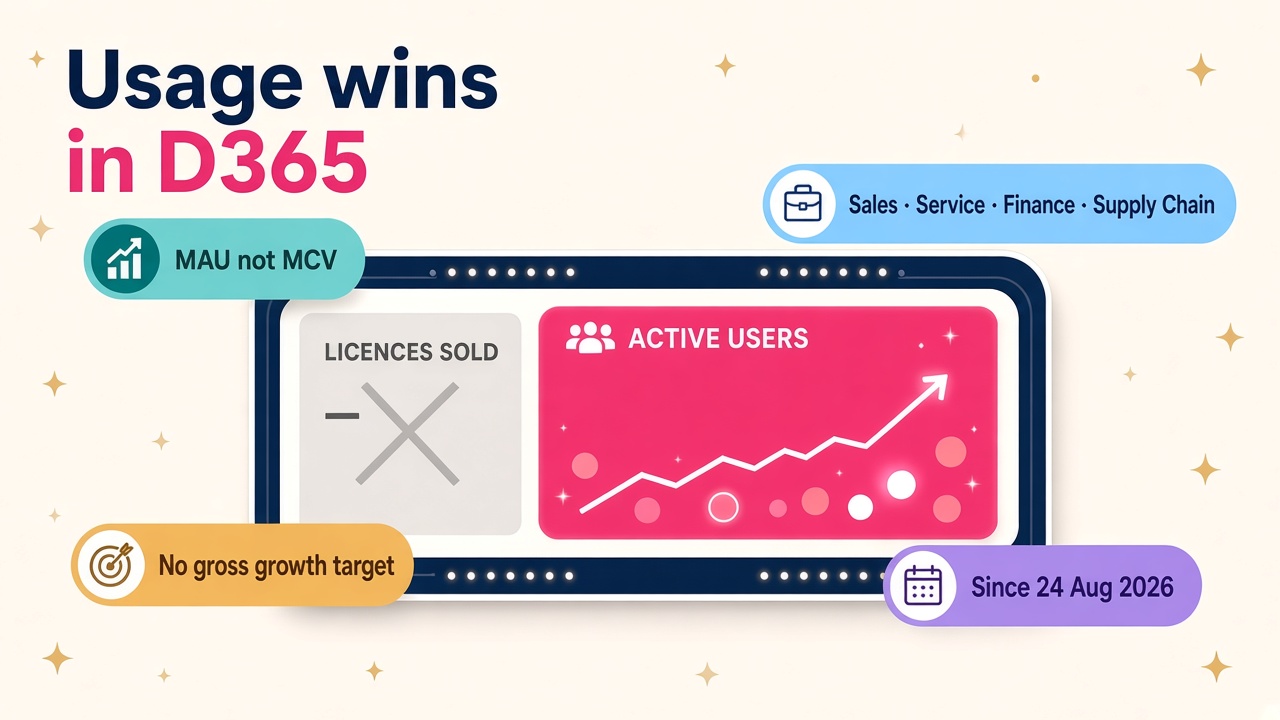
Since 24 August 2026, the Sales, Service, Finance and Supply Chain specialisations in the Microsoft AI Cloud Partner Program count eligible deployments by monthly active users (MAU) instead of monthly consumed value (MCV). The gross growth performance requirement has gone too. Microsoft confirmed it in its October 2026 Partner Center update, dated 22 October, after first flagging it in the August announcements.
That reads like dry programme admin. It isn't. It changes what a partner gets rewarded for, which changes who partners want to hire, which changes what you should be getting good at.
What actually changed?
Here is the plain version, straight from Microsoft's wording:
- Eligible deployments are now defined by MAU instead of MCV for the Sales, Service, Finance and Supply Chain specialisations.
- The gross growth performance requirement is being removed for those four.
- Microsoft Marketplace tags are being updated to match current products.
MCV is essentially licence revenue. MAU is people logging in and using the thing, month after month. Under the old model, a partner earned credit when a customer paid. Under the new one, the credit comes when the customer's people actually use Dynamics 365.
DynamicsFocus summed it up nicely: for years the incentive pointed at the go-live. You sell it, implement it, hand it over and move on, and an unused licence still counted. Not any more.
Why is this such good news?
I have been around business software and recruitment tech long enough to know that shelfware has been the dirty secret of this industry forever. Licences bought, half the team never trained, a few power users doing everything and everyone else exporting to Excel. Everyone knew. Nobody was paid to fix it.
Now somebody is. When the partner's specialisation status depends on active users, adoption stops being a nice-to-have phase at the end of the statement of work and becomes the thing the whole engagement is judged on. That is better for customers, better for the partners who do good work, and very good for the people who make systems stick.
It also lines up neatly with where the product is heading. Microsoft is pushing D365 into Teams, Outlook and Copilot. Its October partner briefing on new AI capabilities across business apps lists CRM in the flow of work in Teams and the Sales Development Agent (both in public preview from 8 October), and Sales and Service skills generally available in Copilot and Cowork from the same date. More ways to touch D365 means more chances to be an active user, and more work making sure those experiences are actually switched on, configured and trusted.
Who becomes more valuable?
If adoption is the scoreboard, the people who drive adoption become some of the most valuable people a partner can have. In practice, that means a few roles get a lot more airtime.
Functional consultants who can teach
The consultant who can stand in front of a finance team, explain month-end in Dynamics 365 Finance in their language, and get them to stop using the spreadsheet is worth their weight in gold. Configuration skills still matter, but the ability to train, coach and win over sceptical users is now directly tied to the partner's status.
Customer success and adoption managers
Partners will want people who watch usage after go-live, spot when a team drops off, and do something about it. Expect more customer success, adoption lead and managed services roles inside D365 partners, and expect those roles to be taken more seriously than they used to be.
Solution architects who design for real people
An architect who builds something people want to open every day beats one who builds a technically perfect system that nobody likes. Simpler forms, sensible security roles, Copilot and agent experiences that remove clicks rather than add them. Those design choices now show up in the numbers.
Change and training specialists
Change management has often been the first thing cut when a project budget gets squeezed. With MAU in play, partners have a commercial reason to keep it in. If you have Prosci, training design or digital adoption platform experience alongside D365, that combination should now be easier to sell.
What about the money side?
There is a related shift in incentives. Microsoft's refreshed FY27 Business Applications Presales Advisor incentive launched on 1 October 2026, and according to Sherweb's November round-up it now lets partners claim CSP-based customers (as long as they aren't also the transacting partner of record), updates the Finance and Supply Chain Management rate, and adds new workload levers for Contact Center and Business Central.
Put that together with the MAU change and the picture is clear. Microsoft wants partners helping customers choose well, deploy well and keep using what they bought. Presales people who can scope honestly and set realistic adoption plans are part of that story too.
I wouldn't expect salaries to jump overnight because of a programme rule. But when a partner's specialisation, badges and search ranking depend on adoption, the people who deliver it get a stronger seat at the table in pay reviews. That is worth knowing before your next one. Have a look at our D365 salary data to see where you sit.
Will partners actually behave differently?
Some will, quickly. Others will carry on as they were until a renewal tells them otherwise. Specialisations are a big deal for partners because they unlock badging, Microsoft co-sell visibility and customer trust, so most will at least look at their numbers.
The realistic risk is that some partners treat it as a reporting exercise rather than a service change. If you are interviewing with one, ask how they measure adoption after go-live and who owns it. A clear answer tells you a lot about whether they will value what you do. A vague one is also an answer.
What does this mean if you work client-side?
If you run Dynamics 365 in-house, your partner now has a real commercial reason to care whether your users are getting value long after go-live. Bring that into your next account review. Ask them what they will do to lift usage in your weakest team this quarter. You are well within your rights to expect more than a support ticket queue.
And if you are the internal D365 lead who has been banging the drum about training for years, this is useful ammunition. Adoption is now something Microsoft and your partner are both measuring.
Practical things you can do this week
Here is a list you can actually work through, whether you are a consultant, architect or contractor:
- Rewrite your CV around adoption outcomes. Not "configured Dynamics 365 Sales", but something like "took the sales team from patchy use to daily use after go-live", if that is genuinely what happened. Real numbers you can back up beat adjectives.
- Add a "post go-live" section to your project stories. Interviewers will start asking what happened after cutover. Have two or three honest examples ready.
- Learn how usage is measured. Get familiar with the usage and adoption reporting available in the Power Platform admin centre and Dataverse, and how your clients' licence assignments map to actual sign-ins.
- Get hands-on with the new front doors. Try the Sales and Service skills in Copilot and Cowork and the Teams CRM experience in a trial or sandbox. If users are going to touch D365 through Teams and Copilot, you want to be the person who can set it up and explain it.
- Pick up a change or training qualification. Prosci, a training design course, or simply running proper train-the-trainer sessions on your next project. It all counts.
- Talk about adoption in interviews before they ask. It shows you understand how partners are measured in 2026, which plenty of candidates won't.
- If you lead a team, look at who drives adoption. Make sure those people get credit in reviews, not just the folk who hit the go-live date.
Where does this go next?
Microsoft Ignite runs from 17 to 20 November 2026 in San Francisco and online, and agentic business applications are front and centre on the agenda according to the October partner blog. As agents start doing more of the work inside D365, the definition of an "active user" is going to get interesting. I'd expect Microsoft to keep tuning how it measures real usage as agents and humans share the load.
Whatever the exact metric ends up being, the direction is right. Value is being measured by what people actually get out of the system, and that is a brilliant thing for anyone who loves seeing Dynamics 365 make a real difference to a business. The partners who lean in will win more work, and the people who make adoption happen will be in demand.
What to do next
- Browse current D365 jobs and look for customer success, adoption and functional roles at partners.
- Check D365 salaries before your next review or offer conversation.
- If you are a partner or employer hiring adoption talent, post a role or find experienced D365 consultants.
- Explore the products and vendors building adoption and digital training tools around Dynamics 365.