D365 ERP Business Skills: The Work IQ Skill F&O Pros Need
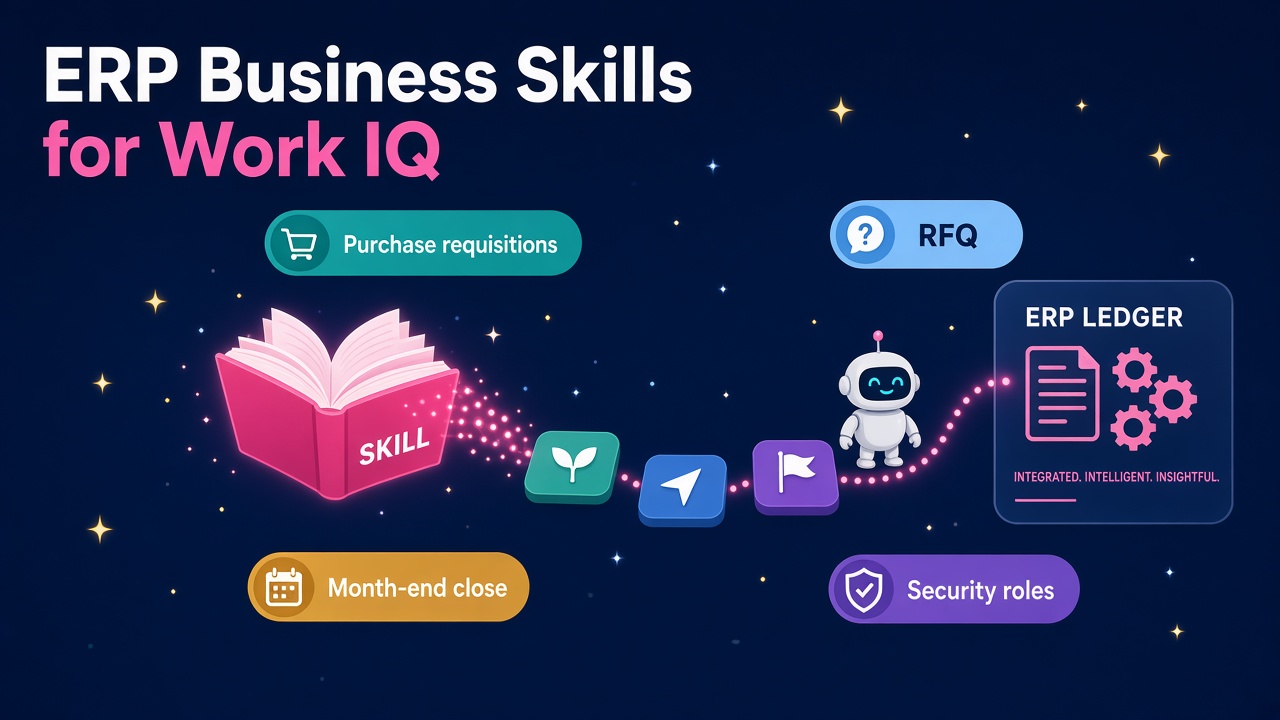
Dynamics 365 ERP in Work IQ brings business skills to finance and operations. Here's what changed at Ignite 2026 and how F&O pros can get ahead of it.
If you work in Dynamics 365 Finance or Supply Chain Management, the most important announcement from Ignite 2026 might not be the flashiest one. On 19 November Microsoft published the detail behind Dynamics 365 ERP in Work IQ, and right in the middle of it sits a new idea every F&O consultant, analyst and admin should get familiar with: business skills.
A day earlier, Microsoft announced that Business Applications in Work IQ is generally available for Sales, Customer Service and Power Apps. The ERP version is in public preview. Put the two together and you get a pretty clear picture of where finance and operations work is heading in 2027.
I think this is great news for people who know how a business actually runs. Let me explain why.
What did Microsoft actually announce?
There are two parts to Dynamics 365 ERP in Work IQ.
1. ERP data and business logic in Work IQ. Work IQ is the intelligence layer that grounds Copilot and agents in your work data. Finance and operations now joins email, meetings, documents and the CRM apps in that layer. A semantic model covers the most commonly used ERP entities, so people can ask questions about ERP data in plain language in Copilot Chat, and a single question can draw on ERP records, email, meetings and documents at the same time.
2. Business skills in Dynamics 365 ERP. The Dynamics 365 ERP MCP server is now part of Work IQ, which gives Copilot and agents access to ERP data and business logic, including updating records and completing processes. Business skills sit on top of that and tell the agent how your organisation does the work.
Microsoft describes a business skill as "a reusable set of instructions that guide an AI agent on how to carry out a specific task the way your organization does it". Each skill defines the goal, the required steps, and the ERP data or actions the agent should use. Their examples include reconciling vendor invoices, chasing late customer payments and preparing a period-end close checklist.
Why business skills matter more than the AI itself
Here is the bit I love. Microsoft is openly saying that access to data is not enough. In their words, an agent "may know how to create a purchase order. However, it may not know your approval thresholds, policies, or completion standards."
That knowledge lives in people's heads, in old process documents and in the experience of the team that has run month-end for ten years. Business skills turn it into something the organisation owns, governs and reuses.
A few details that make this enterprise-ready rather than a toy:
- Security comes from the ERP. Standard ERP security roles protect every skill. You decide who can create or modify skills, which roles can use a skill and which legal entities it applies to.
- Skills travel. They are available in any agent experience that connects to Work IQ or the Dynamics 365 ERP MCP server, whether that's Copilot, Copilot Cowork or another agent.
- Skills can evolve. When a process changes you update the skill, not rebuild the agent.
- Built-in plus custom. Microsoft and software companies ship built-in skills, and customers can customise those or write their own.
If you've ever spent a week documenting a procure-to-pay process for a new joiner, you already know how to think about this. The difference is that the reader is now an agent that will follow your instructions exactly, every single time.
Which skills ship first?
Microsoft is releasing purpose-built skills across three process areas, with more collections to come:
Source to pay
- Purchase requisitions. Cowork helps turn requests from channels such as Outlook into structured purchase requisitions in Dynamics 365.
- Request for quotation. Cowork sets up the RFQ, brings vendor responses together and evaluates bids against your sourcing criteria. The sourcing manager keeps the final award decision.
- Purchase order supplier communications. Supplier emails about confirmations, delays and changes become purchase order updates. Copilot reads the email, sorts out the dates and formats, and applies the change to the right orders.
Project to profit
- Expense. Copilot handles backup reviews and compliance checks at corporate and customer level, and routes exceptions for corrective action.
Order to cash
- Receipt designer. Retail analysts can author, refine, localise and validate receipt formats before publishing.
This builds on what Microsoft announced on 17 November, when the Dynamics 365 ERP apps plugin went generally available with more than 39 finance and operations skills inside Copilot. We covered the wider picture in Dynamics 365 in Copilot: The Ignite 2026 Skill D365 Pros Need.
What partners are already building
The partner examples in Microsoft's post are worth a read, because they show what a well-written skill looks like in real life:
- Avantiico turned the month-end close review into a skill. A controller asks Copilot to "run the close review for September" and gets one read-only report listing outstanding recurring journals, unposted journals and unapproved invoices, each with an owner.
- Crowe built a credit and collections skill that analyses sales order credit holds, customer exposure and aging, then recommends the next action. If the user agrees, the agent can release the order from credit hold, with the decision staying with the person.
- Docentric uses skills in an Invoice Delivery Agent that diagnoses failed invoice deliveries, explains the cause in plain language and resends or fixes delivery rules.
- Commerce Code uses skills to help key account managers simulate trade promotion scenarios and create promotions directly in Dynamics 365.
Notice the pattern. Every one of these is deep process knowledge, packaged. That is exactly what good F&O consultants have been selling for twenty years. Now it can be shipped as a reusable asset rather than a slide deck.
What this means for your career
I am quite certain this is one of the best things to happen to functional F&O people in a long time. For years the worry has been that AI would make functional knowledge less valuable. Business skills flip that. The agent can reach every form, entity and action already. What it lacks is judgement about how your business does things, and that is the functional consultant's whole job.
Here's how I see the roles shifting.
Functional consultants
Your process maps become skills. Clients will want someone who can sit with the AP team, understand how invoices really get approved (not how the policy says they do), and write that down as clear, testable steps for an agent. That's requirements gathering with a much faster feedback loop.
Finance and supply chain analysts
The people who know the approval thresholds, the supplier quirks and the close checklist become the authors and owners of skills. That's a promotion, not a threat. The Avantiico example makes the point nicely: the close checklist "doesn't depend on any one person's memory" any more.
Security and admin roles
Skills are protected by ERP security roles and can be scoped by legal entity. Someone has to design that. If you already know your duties and privileges, you're in demand. Pair this with what we wrote about agent-only security roles.
Technical and developer roles
The Work IQ MCP server and CLI connect clients such as GitHub Copilot, n8n, Claude Code, Codex and Cursor to semantic models and business skills. Developers who can wire F&O into agent workflows, test them and keep them governed will have plenty to do.
Partners and ISVs
Microsoft explicitly says software companies and system integrators can package their process and product expertise as skills. Expect partners to start building skill libraries the way they once built templates and accelerators. If you're at a partner, put your hand up early.
A realistic word on cost and readiness
Let's stay grounded. Dynamics 365 ERP in Work IQ is in public preview, not GA. Microsoft also notes that everyday AI in Copilot Chat is included with the Microsoft 365 Copilot licence, while advanced AI (agents in Copilot Studio and Cowork, and calls through the Work IQ MCP server and API) is billed by usage. So someone needs to understand consumption, which ties neatly into the Copilot Credits skill we wrote about last week.
There's also the usual truth about ERP: garbage process in, garbage agent out. A skill written from a policy nobody follows will produce an agent nobody trusts. The winners will be the teams who take the time to document what really happens.
What to do next
You don't need to wait for GA to get ahead. Here's a practical list you can start on this week:
- Read the two Microsoft posts linked above, end to end. They're short and very clear about what's in preview and what's GA.
- Pick one process you know cold. Purchase requisitions, supplier delay updates or a month-end close checklist are all good starters. Write it out as a goal, numbered steps and the ERP data each step needs. Congratulations, that's your first draft skill.
- Learn the plumbing. Get comfortable with the Dynamics 365 ERP MCP server and what Work IQ admin controls look like in the Microsoft 365 and Power Platform admin centres.
- Brush up on security roles. Knowing how to scope access by role and legal entity is going to be a core skill for anyone deploying agents.
- Watch the Ignite sessions. BRK299 and BRK296 cover business context and Work IQ governance.
- Update your CV and profile. "Business skills", "Work IQ" and "agent governance" are about to start appearing in job specs. Get them on your profile now, backed by something real you've built or tested.
If you're looking for your next F&O role, browse the latest Dynamics 365 jobs and check where you sit on our salary guide. Employers who want people who can do this work can find them through our consultants directory or post a role. And if you're building skills or agents for Dynamics 365, list them on our products and vendors pages.
It's a genuinely exciting time to know how a business runs. The agents are ready to do the work. They just need someone to show them how.