Procurement Agent Impact Analysis: The SCM Skill to Learn
Dynamics 365's Procurement Agent now checks what a late supplier delivery breaks. Here's how impact analysis works and the SCM skills it puts in demand.
Every purchasing team knows the email. A supplier writes in to say the order will land two weeks late, or that only 600 of the 1,000 units will ship. The email itself takes ten seconds to read. Working out what it actually breaks can take the rest of the morning.
That second job is exactly where Microsoft has pointed the Procurement Agent in Dynamics 365 Supply Chain Management. Its impact analysis capability is now in production-ready preview, and it was one of the headline examples when Microsoft announced on 6 November that it had been named a Leader in the 2026 Gartner Magic Quadrant for Cloud ERP for Product-Centric Enterprises.
I think this is one of the more useful agent features Microsoft has shipped for ERP so far, and it quietly rewards a skill set that a lot of SCM consultants already have but rarely get credit for. Here's what it does, where the catches are, and how I'd get ready.
What does impact analysis actually do?
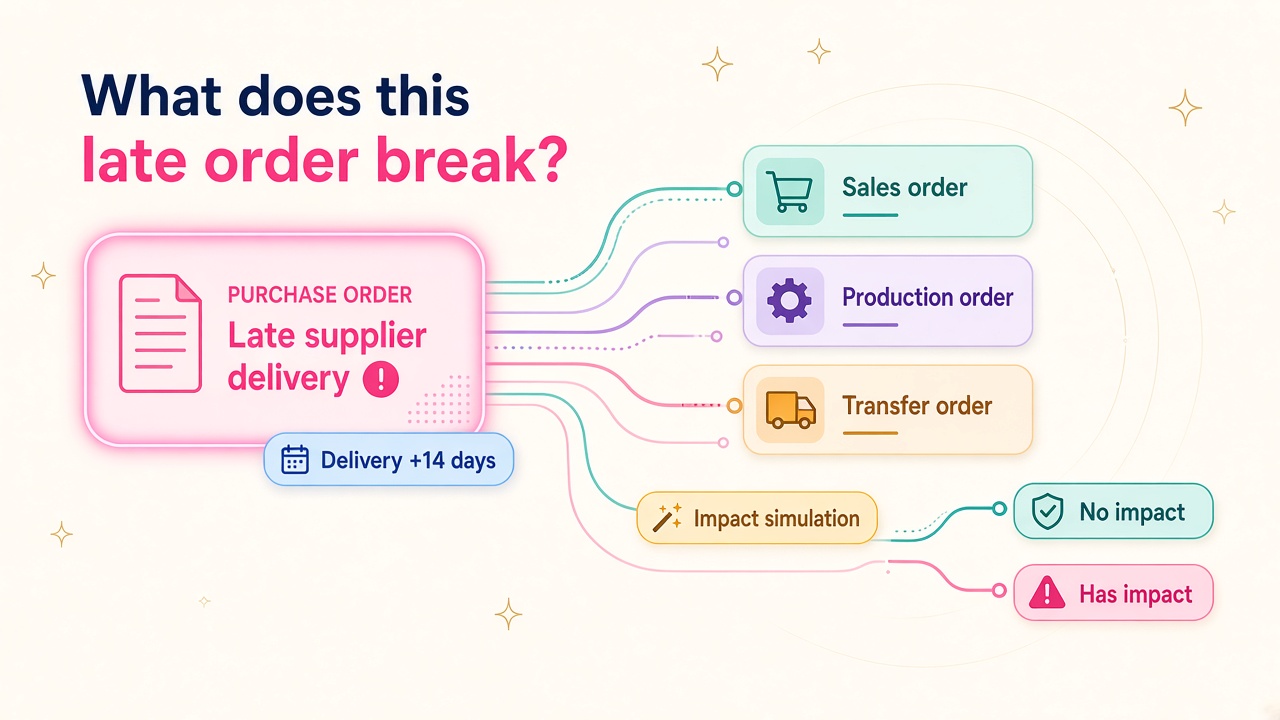
According to the impact analysis overview on Microsoft Learn, when a supplier proposes a change to a purchase order, the agent looks for downstream impact on sales orders, production orders, transfer orders and inventory levels.
It does that by tracing the changed supply through the system to find orders linked to the purchase order through markings and pegging, then checking that trail against confirmed incoming supply and projected on-hand inventory. Each change gets a simple label: Has impact or No impact.
The point is triage. Most supplier changes don't matter much. A delivery that slips three days on stock you hold plenty of is a non-event. Purchasers can accept the harmless changes quickly and spend their time on the ones that threaten a production run or a customer delivery. When a change has to be accepted anyway, they know straight away which colleagues to warn.
Changes can reach the agent in two ways:
- Supplier emails, if you use the supplier communications side of the Procurement Agent. It reads and classifies vendor emails, separates confirmations from change requests and pulls out the changed fields. The impact result then appears in the Emails from vendors workspace.
- The vendor collaboration interface, where change requests land on the "In external review requires action" tab of the Purchase order preparation workspace.
You can switch on supplier communications and impact analysis together, or use just one of them, as the Procurement Agent overview explains.
The simulation mode is the sleeper feature
There's also an impact simulation option that purchasers and planners can run by hand on a selected purchase order. Microsoft lists a few uses: getting a feel for the feature before trusting it with live changes, testing at-risk or high-priority purchase orders where the supplier hasn't replied yet, checking whether a supplier's counter-offer (an earlier partial shipment, a split delivery, a bigger quantity) actually fixes the problem, and analysing changes that arrive through channels that don't trigger the agent automatically, like a phone call.
I really like that last one. A lot of supply chain news still arrives by phone, Teams chat or a quick word with the account manager. Being able to ask "what happens if I accept this?" before you say yes is genuinely valuable, and it's the sort of thing that builds a buyer's trust in the agent.
Is anyone actually using it?
Yes, and the early numbers are encouraging. In the same Gartner announcement, Microsoft said that Farmlands Cooperative, New Zealand's largest farmer-owned rural supplier, consolidated seven ERP systems onto Dynamics 365. The cooperative reports that the Procurement Agent now handles half of its purchase-order-related email traffic, with people keeping oversight, and expects Dynamics 365 to save the team about 20 hours a week.
That's one customer and one quote, so I wouldn't build a business case on it alone. But half of PO email traffic is a big chunk of a buying team's week, and it shows the kind of outcome clients will start asking about in workshops.
What's the catch?
There are two, and both are good news for consultants.
It can only trace the links your system knows about
Impact analysis follows markings and pegging. If a purchase order isn't linked to the customer order or production order it's meant to supply, the agent can't see that dependency. Microsoft's documentation notes that when an external planning system is used, it only considers markings, which are explicit reservations.
So the label is only as good as your planning setup and your stock numbers. A business with patchy master planning, lots of manual workarounds or a fudge of a reservation strategy can get a confident "No impact" that's simply wrong. Akram Abouzeid made the same point on 3 November, and I agree with him. The agent doesn't fix bad data. It makes bad data more visible, faster.
That's why I'm optimistic. Someone has to review master planning parameters, coverage groups, marking policies and inventory accuracy before a client switches this on. That's proper, billable SCM work, and it's the kind of work people with ten years of planning experience do in their sleep.
Every run costs Copilot Studio credits
The agent is billed in Microsoft Copilot Studio credits, with a fixed cost per run and a variable cost based on the number of line changes. Microsoft gives a clear example: if supplier communications reads emails from all vendors in a shared mailbox and impact analysis runs on those emails, credits are consumed whenever any vendor emails about a purchase order change.
That's not a reason to avoid it. It's a reason to design it. Which vendors, which mailboxes, which item groups and which sources should trigger an analysis? Those decisions shape both the value and the bill, and clients will want somebody who can model the cost before the first invoice surprises the CFO. If you've been reading our posts on Copilot Studio agent metrics, this is the same muscle applied to supply chain.
Where's the new work for D365 people?
SCM functional consultants
This is your feature. Clients will need help with:
- Readiness assessments. Is pegging reliable? Are marking policies consistent? How accurate is on-hand inventory by site and warehouse? A short, structured health check is an easy first engagement to sell.
- Configuration design. Choosing sources, vendors and thresholds, and deciding when changes should trigger analysis automatically versus on demand.
- Process redesign. Agreeing what a purchaser does with a Has impact result. Who gets told, how fast, and when do you go to an alternative vendor?
- Testing. Building realistic test scenarios using the simulation mode before a single live supplier email is touched.
Master planning specialists
If you understand master planning, coverage settings and the difference between marking and pegging, you're about to be much more in demand. The quality of the agent's answer depends on exactly what you know. Make sure your CV says so plainly.
Power Platform and Copilot Studio people
The agent runs on Copilot Studio credits and lives alongside the wider agent estate. Administrators who can set up capacity, monitor consumption and report on value per run will be pulled into SCM projects they might not have touched before.
Data and analytics consultants
Clients will want to know whether the agent is right. Tracking how often a No impact label later turned out to have impact, how many hours were saved and which suppliers generate the most changes is a nice reporting project, and it's the evidence a sponsor needs to keep funding the rollout.
How does this fit the bigger picture?
Microsoft has been building towards this for a while. The Dynamics 365 ERP MCP server became generally available in January 2026, which makes supported ERP capabilities available to agents through governed services. Supplier Engagement went into preview in July, and I covered that in Supplier Engagement in D365 SCM. The Gartner post also talks about ERP apps joining Work IQ, with Copilot Cowork handling multistep tasks like preparing a supply review.
Put simply, supplier data gets cleaner, agents get better context, and buyers move from chasing emails to making decisions. Impact analysis is where that starts to feel real on the shop floor, because it answers a question every buyer asks several times a day.
What I'd do this month if I were an SCM consultant
- Read the docs properly. Start with the Procurement Agent overview and the impact analysis overview, then the cost pages. It's a couple of hours well spent.
- Get hands-on in a sandbox. Set up a few purchase orders marked and pegged to sales and production orders, then run the simulation with a late delivery, a short shipment and a cancellation. Then break the pegging on one and see what the agent says.
- Write a one-page readiness checklist. Planning parameters, marking policy, inventory accuracy, vendor mailbox setup, credit budget. Clients love a checklist they can tick off.
- Build a simple credit estimate. Take a client's monthly volume of supplier change emails and line changes, and show how configuration choices change the run count. Even a rough model makes you look very good in a steering meeting.
- Update your profile. Add Procurement Agent, impact analysis and master planning experience to your consultant profile, and be specific about what you tested.
Is the hiring market ready for this?
Not by name yet, and that's the opportunity. Job ads rarely mention a preview feature, but partners pitching SCM work right now are being asked about agents in almost every conversation. The people who can explain, in plain English, why a Has impact label might be wrong and how to fix the data behind it will win the interview. Have a look at the live D365 jobs and the salary guide to see where SCM pay is sitting, and keep an eye on the products and vendors directories, because ISVs selling planning and procurement add-ons will have to show how they work alongside Microsoft's agent.
I've spent a long time watching ERP features promise to save buyers time. This one is practical, honest about its limits and built on the data skills the SCM community already has. That's a great combination.
What to do next
- Browse live Supply Chain and F&O roles and see who is hiring.
- Check current SCM pay on the salaries page.
- Create or update your profile in the consultant directory so partners can find you.
- Hiring SCM or master planning talent? List your roles on the employers page.