Power Apps Agentic Authoring: What Makers Must Learn Now
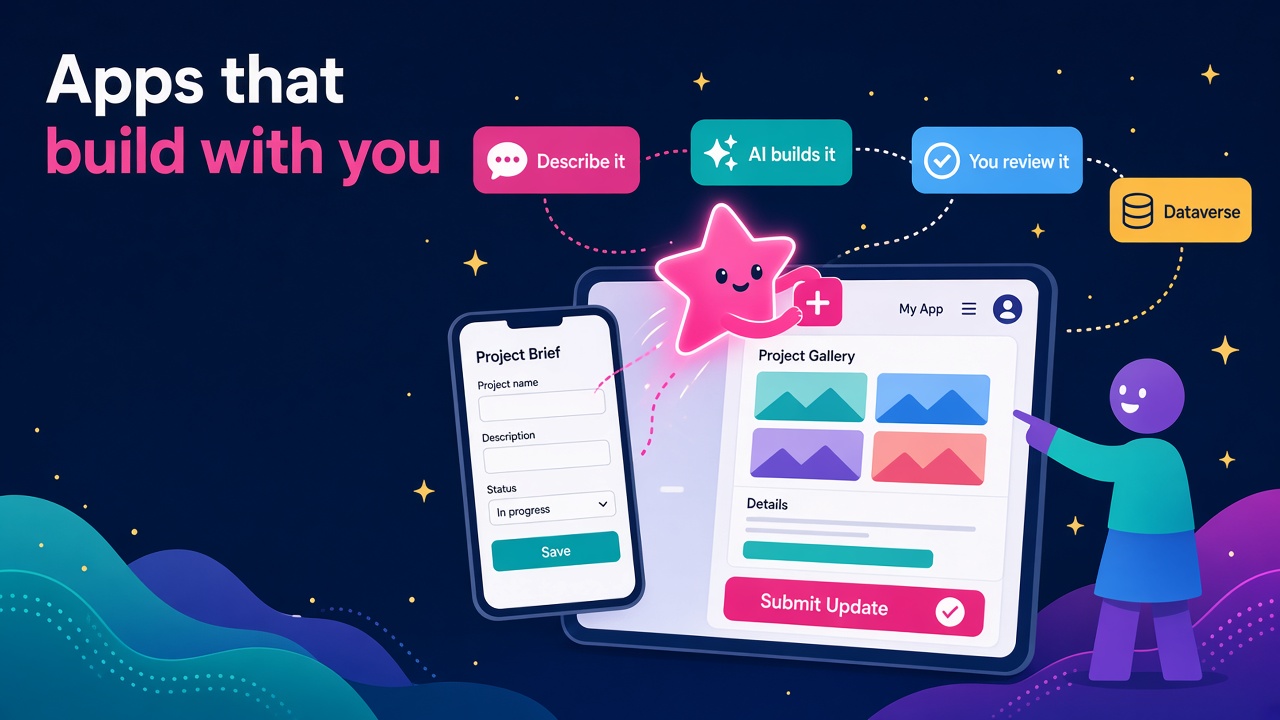
Power Apps now has agentic coauthors in canvas studio and a Dataverse plugin for Cowork. What changed, what it means for makers and the skills to learn now.
If you build canvas apps for a living, the last two months have quietly changed your job description. On 1 September Microsoft made the canvas authoring agent plugin generally available, so coding agents like GitHub Copilot CLI and Claude Code could build and edit canvas apps. On 27 October it went a step further and put agentic coauthors right inside canvas studio, now in preview. A day later the Dataverse plugin for Copilot Cowork showed one prompt turning into tables, relationships, sample data and a published app.
I think this is great news for Power Platform people. Not because the tools replace you, but because they take away the fiddly bits and leave you with the work clients actually pay for: understanding the business, designing the data and making sure the thing is safe to run. Let's look at what has actually shipped, what it means for your career and what to do about it this week.
What has Microsoft actually shipped?
There are three pieces worth knowing, and they fit together nicely.
The canvas authoring agent plugin (GA, September)
This is the foundation. The plugin gives a coding agent a dedicated toolset through an MCP server. According to Microsoft, agents can create and modify apps and screens, inspect controls, connectors and data sources, understand data-source schemas, add and configure controls, write and update Power Fx, and validate changes before syncing them to a live coauthoring session.
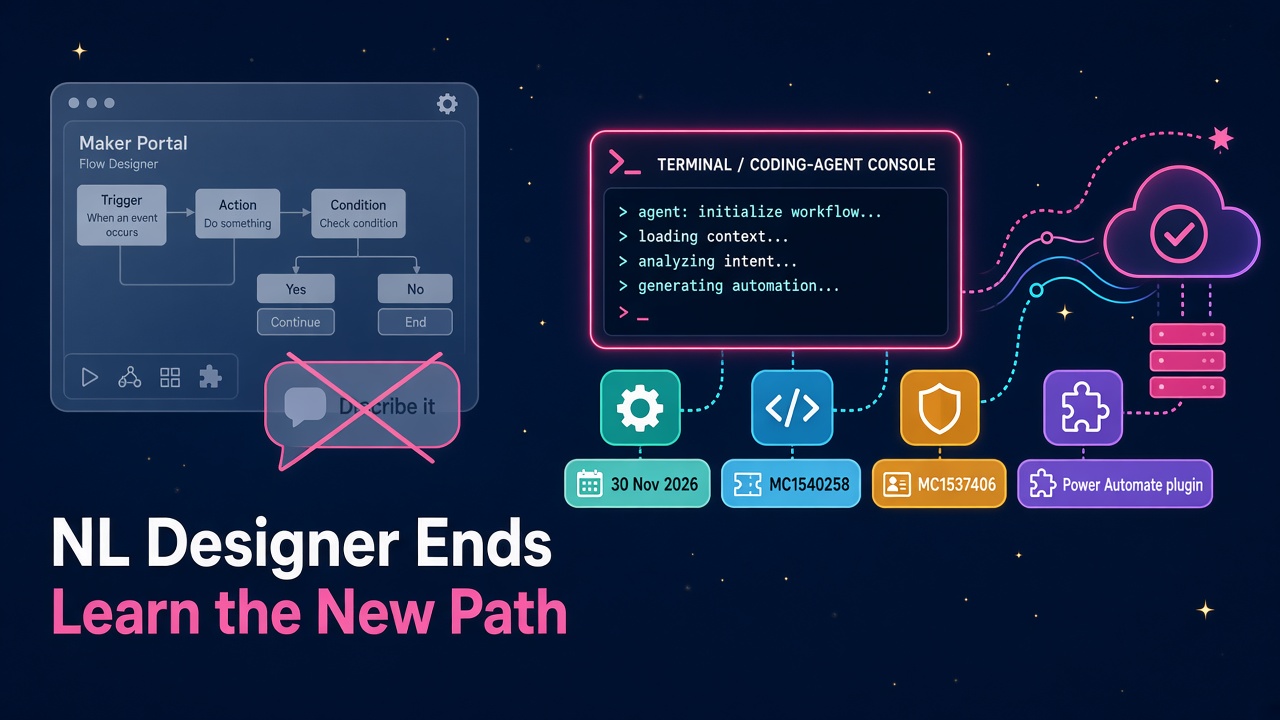
The Microsoft Learn setup guide explains the mechanics. The agent generates .pa.yaml files that define your screens, controls and formulas, validates them against the canvas authoring MCP server, fixes its own errors and then syncs with Power Apps Studio. You need the .NET SDK 10.0 or later and a coding agent that supports MCP servers and plugins. You install it from the microsoft/power-platform-skills marketplace, which also carries plugins for Power Pages, model-driven apps, PCF, Power Automate, process intelligence and Dataverse.
The important line in the announcement is that the result is still a traditional canvas app. Your connectors (Microsoft quotes more than 1,400), governance, testing, accessibility and deployment practices all carry on as before.
Agentic coauthors in canvas studio (preview, 27 October)
Makers told Microsoft they didn't want to bounce between a terminal and the studio, so the agent now sits beside the canvas. An admin turns on a tenant setting in the Power Platform Admin Center, an agentic authoring icon appears in the left rail for new and existing apps, and you sign in with your GitHub.com account. You describe what you want, the agent proposes a plan, you agree or change it, and it gets to work.
Microsoft's own example is a good one: need a change replicated across every screen of your app? Ask the agent. That's the sort of job that used to eat a Friday afternoon.
The Dataverse plugin for Copilot Cowork (28 October)
This one is aimed a bit higher up the stack. In Microsoft's demo, a single prompt for a community event registration app produced an Event table, an Event Registration table linked to the existing Contact table (rather than a fresh list of people), sample data flagged as sample data, waitlist logic once an event filled up, and finally a published app with Organizer and Check-in views.
Before publishing, Cowork ran type checking, linting, a full build and a visual review of the layout. Every change came to the user first as an approval card, and the connection signs in as you, so it can only see and change what your Dataverse security roles allow. One caveat: building apps in Cowork currently needs enrolment in the Frontier program, and the published app runs in Microsoft Copilot Managed Runtime, which is in preview.
So is this the end of the Power Apps developer?
No. I'm quite certain it's the opposite, but the role is changing shape fast.
Think about where the hours go on a typical canvas app project. A decent chunk goes on repetitive build work: laying out screens, copying patterns, wiring galleries to data, fixing the same formula in twelve places. That's exactly the work these agents are designed to take. Microsoft even says so directly, pointing the agent at tasks that are "complex or tedious to execute by hand".
What the agent can't do on its own is decide what should be built. Look at the Dataverse demo again. The clever bits weren't the screens. They were linking registrations to existing contacts, enforcing one registration per person per event and handling the waitlist. Somebody had to know to ask for those things. That somebody is you.
So the value moves in three directions:
- Up into design. Data modelling, business rules, security roles and solution architecture matter more, not less, when an agent can produce an app in minutes. A bad data model built quickly is still a bad data model.
- Into review. Agents propose plans and approval cards. Someone with real Power Fx and Dataverse knowledge has to read them and say yes, no or "not like that".
- Into governance. Admins now decide whether the tenant setting is on, which environments makers can use and how agent-built apps get managed. That's real work, and partners will charge for it.
Maker work isn't disappearing. A good maker with an agent beside them should simply get far more done in a week than they used to.
What does this mean for hiring?
Demand for Power Platform skills is already healthy. As I write this, a search for "Power" on our jobs board returns 199 live roles, with titles like Power Platform Developer at Ceox in Guildford, Especialista en Power Platform y Copilot Studio at Auren in Madrid, and Power Platform and Copilot Developer at Rockwell Automation in Pune. Notice how often "Copilot" now sits right next to "Power Platform" in the title. Employers are already asking for both.
My read is that job ads will start mentioning agentic authoring, MCP and coding agents within months, the same way "Copilot Studio" crept into Power Platform ads over the past year. The people who can say "I've built and shipped canvas apps with an agent, and here's how I kept it governed" will stand out in interviews. That's a lovely position to be in while most of the market is still catching up.
For partners, the maths is interesting too. If an agent handles the repetitive build, a fixed-price canvas app project gets cheaper to deliver. Smart partners will use that to win more work and put their senior people on discovery, data design and adoption, which is where clients see the value anyway. If you're an employer weighing this up, our employers page is a good place to start looking for people who already work this way.
The skills to build now
Here is a practical list. None of it needs a big budget.
Learn the setup properly
- Get a free developer environment through the Power Apps Developer Plan. Microsoft recommends it as the place to try the Dataverse plugin, and it's perfect for experimenting with canvas agents without touching production.
- Install the .NET 10 SDK and a coding agent that supports MCP and plugins. GitHub Copilot CLI and Claude Code are the two Microsoft names; start with whichever you have access to.
- Add the marketplace with
/plugin marketplace add microsoft/power-platform-skills, then install with/plugin install canvas-apps@power-platform-skills, and run/configure-canvas-mcp.
Practise the human parts
- Write better briefs. The prompt in the Dataverse demo reads like a mini functional spec: entities, fields, rules, edge cases. Practise writing specs like that for apps you've already built, then hand them to the agent and compare.
- Review like a lead developer. Read every plan the agent proposes. Check the Power Fx, the delegation warnings and the data calls. Correct it once and clearly when it gets something wrong.
- Know when to type it yourself. Microsoft makes the point that you choose when to spend tokens. Small changes like a label or a colour are quicker by hand. Big repetitive changes are where the agent earns its keep.
Get the governance story straight
- Understand the tenant setting that enables agentic authoring in canvas studio and who in your organisation should own it.
- Be ready to explain that Cowork signs in as the user, respects Dataverse security roles and asks for approval before every change. Clients will ask, and a clear answer builds trust fast.
- Keep your ALM habits: solutions, environments and deployment pipelines all still apply because the output is a normal app.
How should you talk about this in an interview?
Don't just say "I use AI". Everyone says that. Be specific. Something like: "I rebuilt our inspection app with the canvas authoring plugin. The agent created the screens and formulas from my spec, I reviewed each change, fixed two delegation issues by hand and shipped it through our normal pipeline." That tells a hiring manager you know the tool, you know its limits and you still own the outcome.
If you're freelance, the same story works on a proposal. Clients want speed and safety. Agentic authoring gives you the speed, and your governance know-how gives them the safety. Make sure your consultant profile says so.
And if you're wondering what this kind of experience is worth, keep an eye on our salary data. Power Platform roles that blend app building with Copilot and agent skills are the ones to watch.
A word on realism
These tools are new. Agentic authoring in canvas studio is in preview, building apps in Cowork needs Frontier enrolment, and Copilot Managed Runtime is in preview too. Expect rough edges, and don't promise a client a production app built entirely by an agent next week. Treat it as a very fast junior developer who never gets bored: brilliant at volume, still needs a good lead.
That's fine. The direction is clear, Microsoft is shipping quickly, and the people who learn it now will be the ones teaching everyone else next year.
What to do next
- This week, set up a developer environment and install the canvas apps plugin from power-platform-skills.
- Take one existing app and ask the agent to make a repetitive change across every screen. Review every step.
- Write a one-page spec for a small Dataverse app and try it in Cowork if your organisation is in the Frontier program.
- Add agentic authoring to your CV and your consultant profile once you've shipped something real.
- Browse live Power Platform jobs to see how employers are describing these skills, and check the products and vendors directories for tools that sit alongside Power Apps.