Dynamics 365 Sustainability: The New ESG Skill for D365 Pros
Microsoft Sustainability Manager is now Dynamics 365 Sustainability, part of the ERP family. Here is the ESG work it creates and how D365 pros can get ahead.
Microsoft has quietly handed D365 professionals a new door to walk through. Microsoft Sustainability Manager is now called Dynamics 365 Sustainability, and it has moved into the Dynamics 365 ERP family, right alongside Finance, Supply Chain Management and Project Operations.
On paper it is a rename. In practice I'm quite sure it is one of the more interesting career signals of the year, because it puts carbon data in the same room as the general ledger. And whenever Microsoft moves something into the ERP room, the people who already know that room get first dibs on the work.
Here is what has actually changed, what hasn't, and how you can get ahead of it.
What did Microsoft actually announce?
On 3 November 2026 the Microsoft Dynamics 365 Blog published Bringing sustainability into the Dynamics 365 ERP portfolio. Georg Glantschnig, Corporate Vice President for AI ERP, summed it up on LinkedIn as "Welcome to the family", saying the product brings "sustainability closer to the financial and operational processes that drive business decisions".
The detail worth knowing:
- It is the same product with a new home. Microsoft's own product FAQ says plainly that Dynamics 365 Sustainability is not a new product. It is the new name for Sustainability Manager, now part of the ERP portfolio.
- Tiers and costs haven't moved. Analyst firm Directions on Microsoft reported on 28 October that tiers, features and costs are unchanged, and that costs are still driven by Dataverse storage, consumption-billed AI features and the external ESG supplier portal.
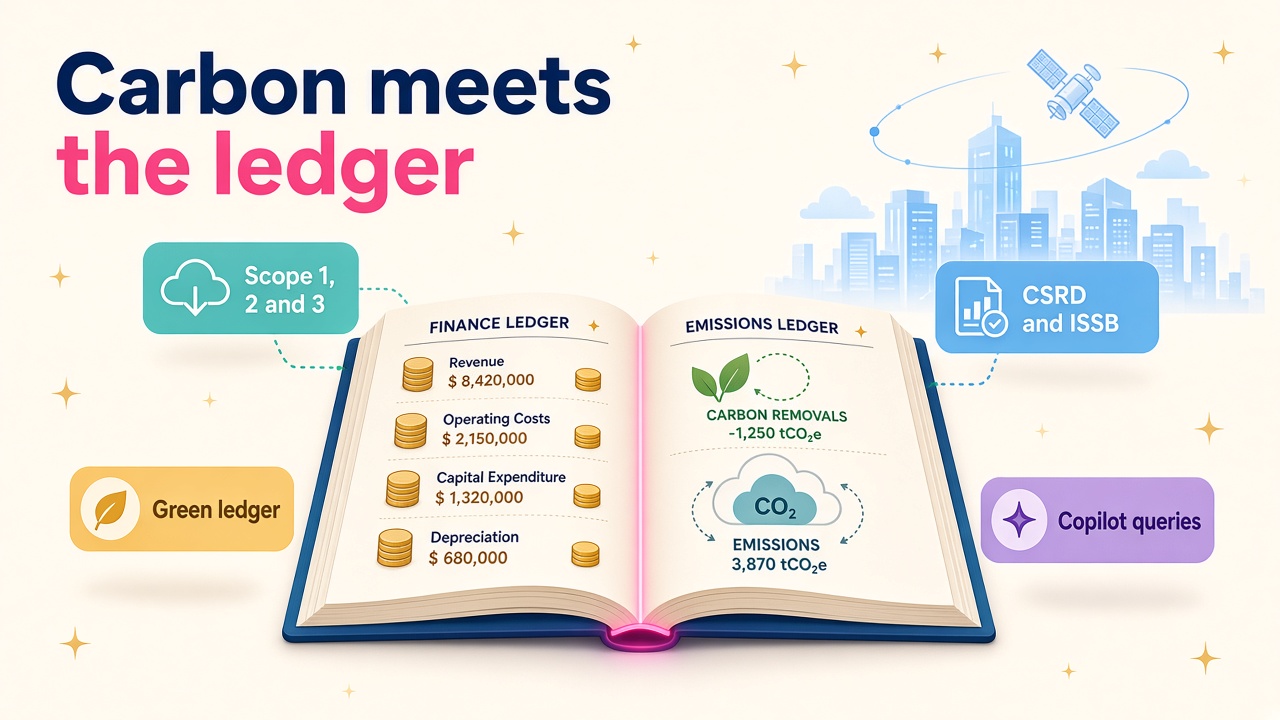
- Finance gets a "green ledger". The same Directions report says Dynamics 365 Finance is receiving a green ledger report that combines financial and emissions data. That is the bit that should make every Finance consultant sit up.
- It is pitched as agentic ERP. Microsoft is positioning it inside its wider agentic ERP push, the same story behind recent launches like Rental Management in Supply Chain Management.
The signal had been building for a while. At Directions for Enterprise 2026 in September, Terra Reporting noted that the move into the Dynamics 365 family was one of the key messages of Microsoft's sustainability session.
What does the product do?
If you have never opened Sustainability Manager, here is the short version from Microsoft Learn. It is built around three verbs: record, report and reduce.
Record
It pulls in carbon, water, waste and energy data, plus quantitative social and governance metrics, and calculates Scope 1, 2 and 3 emissions. Scope 2 can be reported using both location-based and market-based methods, and supplier emissions and product carbon footprint data help firm up Scope 3. Data comes in from Dynamics 365 and other business systems through Power Query and Dataverse connectors.
Report
There are dashboards for emissions, renewable energy, water and waste, plus a deep analysis tool. Microsoft says it supports disclosure preparation for CSRD, GRI, IFRS Sustainability Disclosure Standards and SASB, with materiality assessment and data export to prepare for XBRL tagging.
Reduce
Teams can set targets, track progress and plan reduction initiatives. There is also a Copilot experience for querying sustainability data in natural language, currently in preview.
The licensing in a nutshell
Microsoft's product page lists two tiers:
- Essentials covers foundational carbon, water and waste data, Scopes 1 and 2 and multiple Scope 3 categories, with 10 GB of Dataverse capacity.
- Premium adds the rest of Scope 3 (categories 10, 11, 14 and 15), product carbon footprint management, the ESG value chain solution in preview, AI-powered insights and Copilot in preview, 25,000 AI Builder credits and 50 GB of Dataverse. Microsoft lists Premium at US$12,000, tenant licence paid yearly, with per-user licences on top.
That price point tells you something. This is aimed at serious mid-market and enterprise organisations, which are exactly the businesses already running D365 Finance and Supply Chain.
Why does a rename matter for your career?
Because buyers buy from the shelf they are standing in front of.
When sustainability sat in a separate industry cloud, it was often a separate conversation, a separate budget and frequently a separate partner. Now it sits in the ERP portfolio next to Finance. A CFO reviewing their D365 roadmap will see it on the same page as the general ledger, and the partner already doing their Finance work is suddenly well placed to scope it.
Directions on Microsoft read the move as a deliberate attempt to sell sustainability reporting as part of the ERP suite rather than as a stand-alone product. I think that is spot on, and it is good news for anyone in the D365 ecosystem. It turns ESG from a niche specialism into an add-on skill for people who already speak ERP.
And the regulatory tailwind is real. In Australia, mandatory climate-related financial disclosures under AASB S2 began for the largest entities with financial years starting from 1 January 2025, with further groups phasing in from July 2026 and July 2027. In Europe, CSRD has pulled thousands of companies into structured sustainability reporting. Every one of those organisations needs clean, auditable numbers, and auditors care about the same controls and traceability that finance teams have lived with for decades.
That is the opportunity in one sentence: sustainability reporting is starting to look a lot like financial reporting, and finance systems people are the ones who know how to make numbers survive an audit.
Who should care most?
D365 Finance consultants
The green ledger is your new party trick. If you can explain how operational spend and activity data turn into emissions figures alongside the financial postings, you can have a conversation with a CFO that most sustainability specialists can't. Learn the basics of emissions factors and Scope 1, 2 and 3, and you will be very hard to beat in a workshop.
Supply Chain and procurement specialists
Scope 3 lives in the supply chain. Purchased goods, transport, use of sold products and end-of-life treatment all trace back to data that already flows through D365 SCM. Supplier data collection through the ESG supplier portal is a natural extension of the supplier work many of you are already doing.
Power Platform and Dataverse people
Everything here runs on Dataverse, and data ingestion runs through Power Query and connectors. Directions also flagged that Dataverse storage is one of the main cost drivers. Anyone who can design a lean, well-governed data model and keep storage costs sensible will be valuable on these projects. If you read our recent post on Dataverse storage validation, you will see why that skill is getting more attention.
Data and reporting specialists
Dashboards, Power BI, XBRL export and disclosure preparation. This is reporting work with real deadlines and real regulators behind it. That tends to mean budget.
Functional architects and pre-sales
The bundle story is now easier to tell. If you can sketch how Finance, SCM, Project Operations and Sustainability share one data foundation, and where agents fit in, you are offering something genuinely joined up.
Where are the agents in all this?
Microsoft is clear that Sustainability sits inside its agentic ERP portfolio. Right now the visible AI pieces are the Copilot query experience in preview and the AI-powered insights in the Premium tier. Glantschnig's post talks about helping organisations "move beyond measuring environmental impact to making informed decisions and taking action".
I'd keep expectations realistic here. Agents won't magically produce audit-ready disclosures. But the boring, repetitive parts of sustainability work, such as chasing supplier data, flagging gaps, mapping activity data to the right categories and drafting commentary, are exactly the kind of jobs agents are getting good at. Consultants who learn to design those workflows, with a human signing off on anything that goes to an auditor, will be well ahead.
What should you learn first?
Here is a practical list you can start on this week:
- Read the Microsoft Learn overview for Dynamics 365 Sustainability and click through the record, report and reduce sections. It takes an evening.
- Get your head around the scopes. Understand Scope 1, 2 and 3, and the difference between location-based and market-based Scope 2. You don't need to be a carbon accountant, but you do need to hold your own in a meeting.
- Pick one framework that matters in your market. If you work in Australia, read up on AASB S2. In the UK and Europe, get familiar with CSRD and the ESRS. Globally, the IFRS Sustainability Disclosure Standards are the common thread.
- Spin up a trial or sandbox and load some sample data. Building one Power Query ingestion flow from a spreadsheet of fuel or electricity usage will teach you more than any slide deck.
- Map one real process. Take a purchase-to-pay or fleet process you know well in D365 and write down where the emissions data would come from. That one-page map is a brilliant conversation starter with clients and hiring managers.
- Learn the cost levers. Know that Dataverse storage, AI consumption and the supplier portal drive cost, so you can scope projects honestly.
- Update your profile. Add "Dynamics 365 Sustainability" and "ESG reporting" to your LinkedIn and CV once you have done the groundwork. Recruiters search for these exact phrases.
How will this show up in hiring?
Honestly, it will start slowly and then show up everywhere. The first wave will probably be partners adding sustainability to existing Finance and SCM practices, then customers asking for it as a phase-two item on ERP projects. Job ads will start asking for "D365 Finance with ESG reporting experience" long before they ask for a pure Dynamics 365 Sustainability specialist.
That's the sweet spot. You don't need to change careers. You need to bolt a genuinely useful new skill onto the one you already have. Have a look at the latest roles on our D365 jobs board and the salary guide to see where Finance and SCM pay is sitting right now, and keep an eye on how often sustainability starts appearing in descriptions.
For employers and partners, this is a good moment to look at your bench. If you are a D365 employer or one of the vendors building practices, the people who combine ERP depth with ESG fluency are worth finding early, before everyone else goes looking.
What to do next
- Spend an hour this week on the Dynamics 365 Sustainability docs on Microsoft Learn.
- Learn Scope 1, 2 and 3 well enough to explain them to a CFO without notes.
- Build one small Power Query ingestion flow in a sandbox.
- Add the skill to your profile once you can talk about it with confidence.
- Browse the latest D365 roles and products to see where the demand is heading.
Sustainability has just moved into the ERP neighbourhood. If you already live there, go and say hello.