D365 Partner Deals: Engage Buys Enqore, HSO Gets a New CEO
Engage Group is buying Enqore and HSO has a new CEO. What D365 partner consolidation means for jobs, skills and pay, plus the skills to build now.
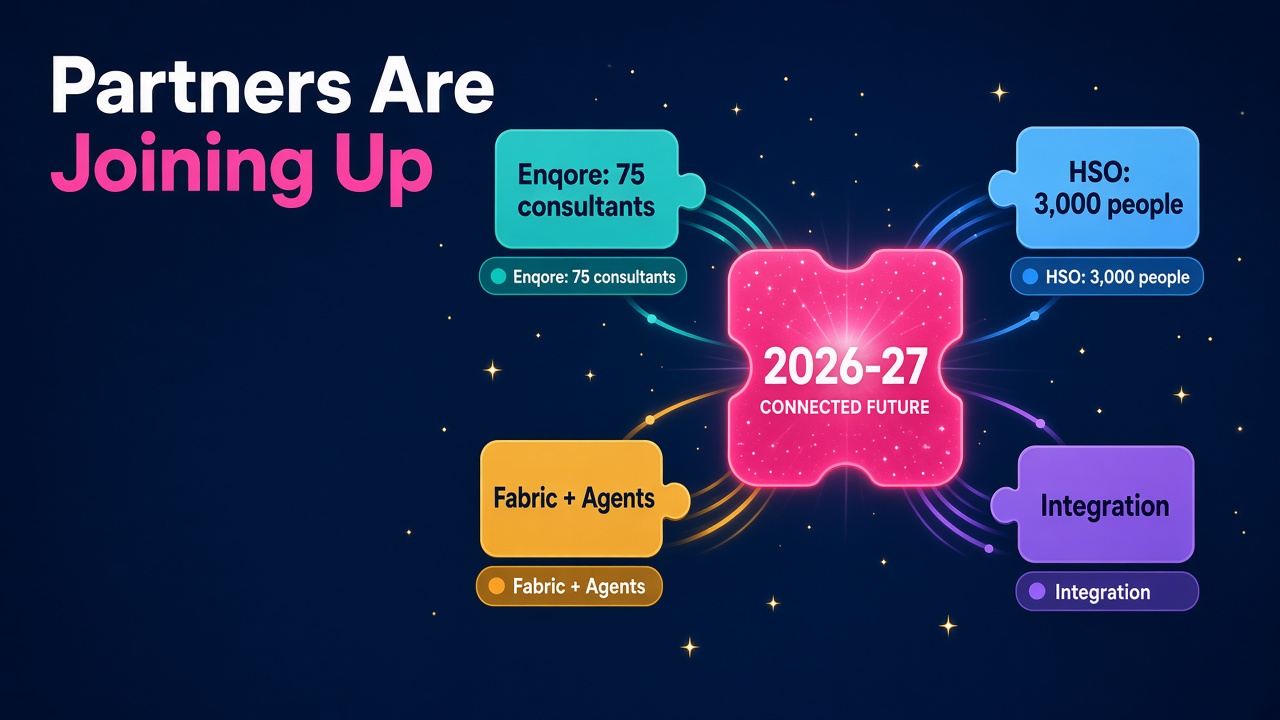
Two bits of Dynamics 365 partner news landed within a day of each other at the start of November, and together they say a lot about where this market is heading. On 3 November, Swedish partner Engage Group agreed to buy Enqore, a Microsoft consultancy with around 75 consultants. A day earlier, it was reported that HSO, one of the biggest Dynamics partners in the world, has a new CEO in former Crayon boss Melissa Mulholland.
One is a mid-sized Nordic deal and the other is a leadership change at a 3,000-person global firm, but the direction is the same. D365 partners are getting bigger, more specialised and far more focused on data, integration and AI agents. If you work in this ecosystem, or you hire from it, that is very good news, as long as you know how to play it.
What actually happened?
Engage Group agrees to buy Enqore
According to Engage Group's press release, dated 3 November 2026, the deal brings together two Microsoft-focused consultancies to strengthen their position as a leading Microsoft Business Applications partner in the Nordic market.
The detail is worth reading closely:
- Enqore has approximately 75 consultants, with offices in Gothenburg, Malmö, Karlstad, Stockholm and Linköping.
- Its work is mainly Dynamics 365 Customer Engagement, data and analytics, integration and change management.
- Engage says the deal gives it capacity for larger and more complex client assignments.
- Enqore's data and analytics team will speed up Engage's Data, AI and Agents offering, particularly within Microsoft Fabric.
- Integration becomes a dedicated offering of its own, so the group can take more end-to-end responsibility.
- Change management broadens what Engage can sell across a whole transformation.
That last pair is the bit I find most interesting. Integration and change management used to be the things partners did quietly on the side of a CRM project. Now they are being named as reasons to buy a business.
HSO appoints Melissa Mulholland as CEO
IT Channel Oxygen reported on 2 November that HSO has appointed Melissa Mulholland as CEO. HSO is Amsterdam-based, has around 3,000 employees and operates across North America, Europe and Asia-Pacific. Its UK subsidiary alone turned over £56.6m in calendar 2025, according to its latest accounts.
A few other facts from the same report:
- Mulholland takes over from founder Peter ter Maaten, who started HSO in 1987 and stays on as a major shareholder and supervisory board member. HSO calls it a carefully planned generational succession.
- She joins about 15 months after Bain Capital acquired HSO for a reported $1bn.
- Before running Crayon she spent more than a decade at Microsoft building its global partner ecosystem.
- HSO says AI is "the biggest opportunity yet" for its mission, and Mulholland said AI lets the firm build on its strengths and deliver even greater results for clients.
When a private equity owned partner of that size hires a CEO with deep Microsoft partner ecosystem experience and talks about AI transformation in the same breath, you can be pretty confident about the growth plan.
Why is this happening now?
This is not a one-off. In October I wrote about four D365 partner acquisitions in six weeks, across Denmark, the UK and Australia. The Engage and Enqore deal keeps that run going, and HSO's appointment shows what the bigger groups are preparing for.
My read on why, based on what the buyers themselves keep saying:
Customers want one partner for the whole job. A modern D365 project is rarely just CRM or just ERP any more. It is Dynamics plus Power Platform, plus Fabric for data, plus Copilot Studio agents, plus integrations to everything else the business runs. Smaller firms often have one or two of those skills. Buyers want all of them under one roof.
AI agents need clean data and joined-up systems. An agent is only as useful as the data and processes it can reach. That is exactly why Engage called out Fabric and integration as reasons for the deal. The partners that can wire it all together will win the agent work.
Patient money is backing the sector. Bain Capital at HSO, private equity behind several of the deals I covered in October, and long-term holding companies elsewhere. Investors clearly believe Microsoft business applications have a long runway.
Microsoft keeps shipping. Just this month we have had new Rental Management in Supply Chain Management in public preview, and the Sherweb November partner update flags new Business Central and Microsoft 365 Copilot Business bundles arriving on 1 January 2027. Every new product area is another skill a partner needs to staff.
What does this mean for D365 professionals?
I'm firmly in the glass-half-full camp here. Consolidation can feel unsettling when it is your employer being bought, but for good people it usually opens more doors than it closes.
Bigger projects, bigger roles
Engage said it outright: the deal gives it capacity for larger and more complex assignments. Bigger projects need solution architects, workstream leads, data leads and delivery managers. If you have been the most senior CE person at a 75-person firm, a larger group can give you a path into those roles that simply did not exist before.
Specialists are suddenly very visible
Integration, data and analytics, Fabric and change management are now headline capabilities, not side dishes. If you have any of these skills, make them prominent on your CV and LinkedIn profile today. A buyer who has just named "integration" as a dedicated offering will be hiring people to lead and grow it.
Leadership and commercial skills are in demand
A new CEO with an AI transformation story will want practice leads who can sell and deliver AI work, not just talk about it. Consultants who can scope a Copilot Studio agent, estimate it, explain the value to a finance director and then deliver it are going to be hard to find and well paid. Have a look at our D365 salary data to see where you sit.
If your firm is the one being bought
Most of these deals keep the brand and the team, because the people are the value. That is good for you. Use the first few months to find out:
- Which practices the new group is investing in, and whether yours is one of them.
- Whether there are new internal roles, such as practice lead or architect, that you can step into.
- What training, certification budget and AI tooling you now have access to.
- How bonus, utilisation targets and career levels will be aligned over the next year.
Ask early and ask politely. New owners generally appreciate people who lean in.
What does it mean for employers and buyers of D365 services?
For end customers, consolidation can mean deeper benches and more end-to-end capability, but it is worth checking that the named people you rely on are staying and that support terms are unchanged. Engage did not publish anything on customer contracts in its release, so ask your account manager directly if you are an Enqore customer.
For partners hiring, the market for people with Fabric, integration and agent skills is going to get tighter as groups like Engage and HSO build out those offerings. If you need these people in 2027, start building relationships now. You can post a role on D365 Market or browse our consultant directory to see who is available.
For ISVs and product companies, larger partner groups mean fewer, bigger buying decisions. Make sure your product is easy to find and easy to evaluate. List it on our products and vendors pages so the right partner teams can discover it.
The skills I'd be building right now
Based purely on what the buyers are saying they want, here is where I would focus over the next three months:
- Microsoft Fabric fundamentals. Learn how D365 data lands in Fabric and how it feeds reporting and agents. Engage named Fabric specifically, and it won't be the last partner to do so.
- Integration patterns. Dataverse, Power Automate, Azure integration services and the new MCP servers for Dynamics 365. Being the person who can connect everything is a very safe place to be.
- Copilot Studio agents. Build at least one agent end to end on real D365 data, and be ready to show it in an interview. We covered a few of the newest agent features in our Copilot Studio agent metrics post.
- Change management and adoption. AI projects fail when people don't use them. If you can run training, measure adoption and fix what isn't working, you are worth a lot to a growing partner.
- Commercial confidence. Practise scoping and estimating AI work. Bigger groups want consultants who can help win the work, not just deliver it.
None of these needs a career change. They are all extensions of what a good D365 consultant already does, and most can be learned on the job or in a few focused weekends.
Where to from here?
I expect more deals before the end of 2026 and plenty more in 2027. The firms buying are telling us exactly what they value: ERP and CRM depth, data, integration, change management and AI agents working together. That is a clear map for anyone wanting to grow a D365 career, and it points to a very bright couple of years for people who keep learning.
What to do next
- Update your CV and LinkedIn profile to name your integration, data, Fabric and change management experience clearly.
- Pick one of the five skills above and block time this week to start on it.
- If your employer has just been acquired, book a conversation with your manager about where the new group is investing.
- Browse the latest D365 jobs to see which partners are hiring for these skills right now.
- Check the salary guide before your next review or interview so you know your worth.