Business Central 29.1: The Master Data Skill BC Pros Need
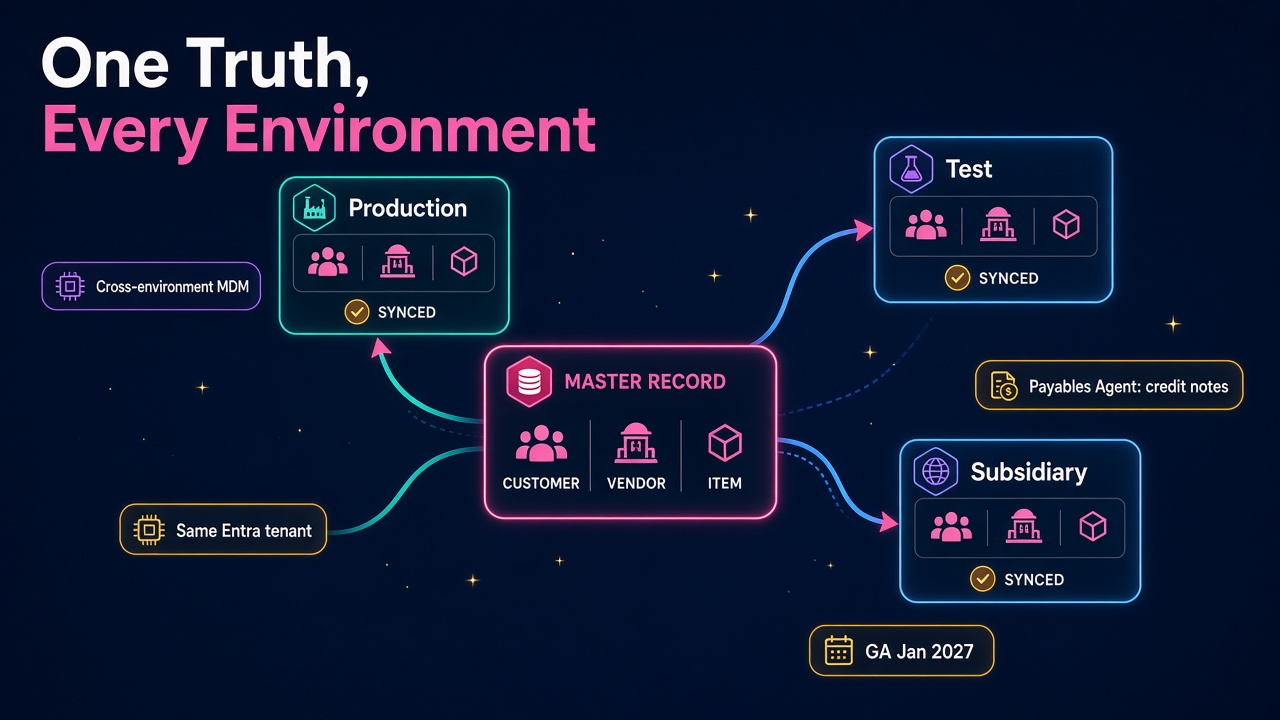
Business Central 29.1 previews cross-environment master data management and lets Payables Agent handle credit notes. Here's the skill and the work it creates.
Business Central 29.1 landed this month, and on the surface it looks like a tidy minor update. Approvals on fixed asset journals, batch totals on payment journals, a few country updates. Nice, useful, not exactly headline material.
Look a bit closer, though, and two features stand out for anyone who earns a living implementing or running Business Central. The first is cross-environment master data management, now in public preview. The second is the Payables Agent processing vendor credit notes, which is now generally available. One is a data governance skill. The other is another step towards finance teams supervising agents rather than keying documents. Both create real work for BC consultants, and I think the people who get hands-on with them over the next couple of months will be the ones customers ring first in 2027.
What actually shipped in Business Central 29.1?
Microsoft's What's New page for update 29.1 lists the full set. The highlights for most partners are:
- Cross-environment Master Data Management (roadmap 573613), public preview.
- Payables Agent can process vendor credit notes (roadmap 577878), generally available.
- Approvals with fixed asset journals and batch totals for payment journals, both generally available.
- Expense Agent improvements in preview, including automatic per-trip expense reports and interim approvers.
- Bonded locations and complex excise duty calculations, in preview.
- Match sandbox database configuration to production, in preview.
- EUDR certification information in Sustainability Management, generally available.
- Country updates including SAF-T audit files for Austria and Iceland, euBP export in Germany and a new non-deductible VAT framework for Belgium.
On top of that, the next major release, version 30, is already available as an early access preview on Business Central online tenants. So the cadence is not slowing down. If anything, the gap between "announced" and "customer is asking about it" keeps shrinking.
Why cross-environment master data management matters
Business Central has had master data management between companies since 2023 release wave 1 (version 22). You could set up a main company, choose the tables and fields to synchronise, filter the records, and let the job queue push changes to subsidiaries. It was genuinely handy when spinning up a new subsidiary.
The catch was that it only worked between companies inside the same environment. Plenty of real customers do not live in one environment. They have a production environment, a test environment, sometimes a separate environment per country or per acquired business, and an awful lot of people quietly re-keying customers, vendors and items across them.
Update 29.1 extends master data management across environments. According to the roadmap entry, the aim is a single source of truth for customers, vendors, products and reference data across development, test and production, with less manual effort and faster environment setup. Public preview started in November 2026, and general availability is currently pencilled in for January 2027.
From the early hands-on write-ups, like this walkthrough on Dynamics 365 Lab, the shape of it is clear:
- A new Cross-environment setup action connects a receiving company to a company in a different environment.
- It authenticates with OAuth through a single-tenant Microsoft Entra app registration, because it only connects environments in the same Entra tenant.
- The app needs the Business Central API permission and has to be added as a Microsoft Entra application inside the source environment with the right permission set.
- Both sides have to accept a privacy notice, because data moves through Microsoft services that may sit outside your chosen geography.
None of that is hard, but every bit of it is the kind of thing a customer's finance manager will not want to do on a Friday afternoon. That is exactly where good consultants earn their keep.
Where the new work is for BC consultants
I am quite certain this feature becomes a standard line item in multi-entity BC projects within a year. Here is where I see the demand landing.
Multi-entity and group structures
Groups that run each country or brand in a separate environment have been living with duplicate vendor masters and drifting item cards for years. Cross-environment sync gives them a clean way out. Someone has to design which environment owns which data, which fields sync and which stay local, and what happens when a subsidiary needs a slightly different payment term. That is a design job, not a click job.
Acquisitions and carve-outs
Business Central customers buy and sell businesses all the time. Standing up a new environment for an acquired company and pre-loading it with group customers, vendors and items used to mean a data migration project. Now a chunk of that can be a sync setup with sensible filters. Partners who can quote that confidently will win the work.
Test and training environments that look like production
Anyone who has run UAT on a test environment with stale master data knows how much time it burns. Pairing cross-environment master data with the new preview option to match sandbox configuration to production makes realistic testing far easier. Expect customers to ask for it as part of every upgrade and go-live plan.
Governance and security
Because the feature relies on an Entra app registration, client secrets and permission sets, it lands right in the middle of IT governance. Customers will want someone to document it, rotate secrets, review permissions and explain the privacy notice to their compliance team. BC consultants who are comfortable in the Entra admin centre are worth more than those who are not.
The Payables Agent now handles credit notes
The second big item is quieter but just as telling. The Payables Agent could already read incoming vendor invoices and draft purchase invoices for review. As of 29.1, it can also recognise a vendor credit note, create a purchase credit memo and apply it to the original invoice, using the same draft and review experience as invoices. Microsoft's roadmap note is upfront about one limit: it does not do return order matching.
That limit is useful information in itself. It tells you where the human work stays for now. Credit notes tied to physical returns still need someone who understands the customer's returns process. Straightforward pricing corrections, rebates and duplicate billing credits are where the agent will shine first.
For consultants, this changes the shape of an accounts payable conversation. You are no longer just configuring purchase documents. You are deciding which documents the agent handles, which ones go to a person, how reviewers check drafts and how you measure accuracy over the first few months. Combine that with the Business Central Expense Agent and the agent footprint inside a typical BC finance team is getting broad very quickly.
Skills to build before general availability
If you work in the BC world, here is a practical list you can get through before January:
- Spin up a sandbox and try cross-environment sync yourself. Create a second environment in a trial or partner tenant, register the Entra app, connect the two and sync a handful of customers, vendors and items. Note every step that confused you, because your customers will hit the same ones.
- Brush up on master data design. Ownership rules, field-level choices, record filters and conflict handling are the real skill here. Revisit how the existing company-to-company master data management works and think through a three-entity group as a worked example.
- Get comfortable in Entra. App registrations, redirect URIs, API permissions and client secret rotation are no longer just the IT team's job if you want to deliver this end to end.
- Run the Payables Agent against real-looking credit notes. Test a pricing credit, a partial credit and one linked to a return, and document what the agent does and does not handle. That becomes your reusable playbook.
- Write a one-page offer. Something like "multi-entity master data health check and sync setup". Partners who package this early will have something concrete to put in front of groups before year end.
- Watch the version 30 early access preview. It is available now on online tenants, and being the person in the room who already knows what is coming next never hurts.
What this means for hiring
Look at the pattern across the last few Business Central updates. Agents for sales orders, payables and expenses, more governance controls, more connections between environments and tenants. The work is moving away from data entry and towards design, governance and supervision.
That is good news for BC professionals. It means fewer hours spent re-keying vendors and more hours spent on work customers value and pay well for. It also means hiring managers are starting to look for a slightly different profile. A BC finance consultant who can talk about agent review workflows and multi-environment data design is a different proposition from one who can only configure posting groups.
If you are hiring, it is worth adding questions about agent supervision and environment strategy to your interview process. If you are looking, put this experience on your CV the moment you have it, even if it is only from a sandbox.
You can see how the market values these skills on our salary pages, and browse current Business Central and D365 jobs to see which employers are already asking for agent and governance experience.
What to do next
- Consultants: set up a cross-environment sync in a sandbox this week, then run the Payables Agent against a few credit notes. Add both to your profile on our consultants directory.
- Employers and partners: review your multi-entity customers and identify who would benefit from cross-environment master data before general availability in January. If you need people who can deliver it, post a role and reach BC talent directly.
- Customers: ask your partner how they plan to handle master data across your environments, and check our products and vendors directories for add-ons that complement it.
- Everyone: keep an eye on the version 30 early access preview. The next wave is already here.