D365 Commerce Trade Counter POS: New Work for Retail Pros
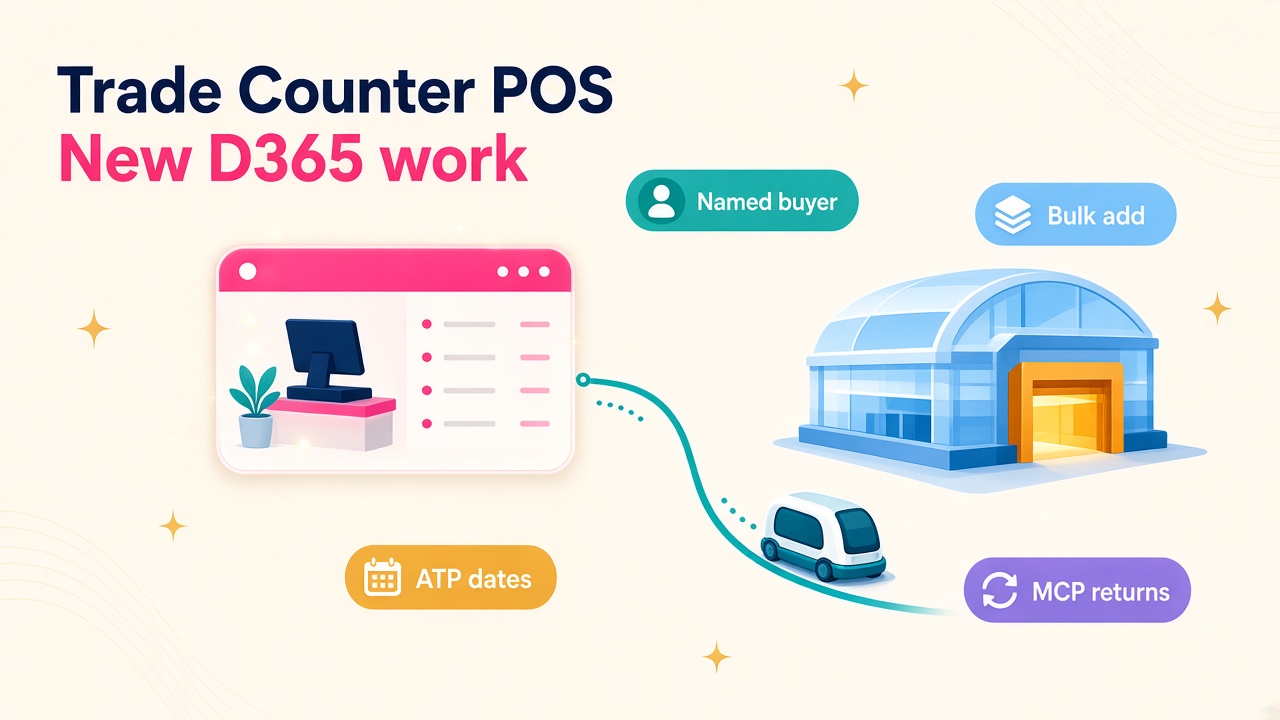
Dynamics 365 Commerce is getting Trade Counter POS, named buyers, ATP dates and MCP returns. Here is the new B2B work and the skills D365 pros need.
Dynamics 365 Commerce has spent years being thought of as the retail app: tills, loyalty cards and a web storefront for consumer brands. That picture is out of date. Over the last few weeks Microsoft has published a run of Commerce roadmap items aimed squarely at the trade counter, the place where builders, electricians, fleet managers and maintenance crews walk in, order 40 lines on account and want half of it on a truck by lunchtime.
If you work in Commerce, Finance or Supply Chain Management, this is one of the more interesting pockets of new D365 work for 2027. Here is what has been announced, why I think it matters, and how to position yourself for it.
What has Microsoft actually announced?
The headline item is Trade Counter POS, published to the Microsoft 365 roadmap on 26 October 2026. It is described as a collection of capabilities for the Store Commerce point of sale that businesses can switch on individually, rather than one all-or-nothing experience. Preview started in October 2026 and general availability is listed for February 2027.
The feature list reads like a wish list from every distributor I have ever spoken to:
- Find customers, organisations and products quickly, with customer history, credit terms and contract pricing on screen.
- Build big carts with bulk add, quick add with partial search, line search, multi-select actions and a filter for lines with errors.
- Create orders for B2B organisation accounts, capture the named buyer and add order notes.
- View margins and override prices within discount authority and margin limits.
- Check stock at the counter, the attached warehouse, other branches and the central distribution centre, with available-to-promise dates.
- Release orders from POS to the Warehouse Management app in Supply Chain Management, including priority release for rush orders, with will-call staging for pickup.
- Charge to account with a purchase order reference, support B2B invoicing and credit management, and print A4 invoices from POS.
Around it sits a cluster of supporting features:
- Contacts on orders and quotations (RM577748, published 5 November, GA October 2026). Associates can stamp the specific person acting for a business customer onto cash-and-carry sales, customer orders, quotations and returns, and the name prints on the receipt. Contacts sync to Finance and Operations in real time.
- Bulk actions on transaction lines (RM577752, GA September 2026). Void items, change delivery mode or change fulfilment location across many lines at once, with line-level validation kept in place. Partners can extend it with their own bulk actions.
- ATP and transfer lead time in inventory lookup (RM577406, preview October, GA December 2026). Associates see available-to-promise quantities and dates across locations, plus the estimated arrival date if they raise a transfer order. There is also a new headless API on Commerce Scale Unit that returns ATP and transfer arrival dates in one call, so POS, e-commerce and third-party channels share one answer.
- MCP tools for POS returns (RM574124, preview October 2026, GA March 2027). Return capabilities exposed as Model Context Protocol tools, so an agent can look up the original purchase, work out what is returnable, create the return and run eligible original-tender refunds through existing Commerce logic. The tools can also flag duplicate-refund risk and frequent-return patterns.
- Receipt formats authored with Copilot Cowork (RM577405, GA December 2026). Create, edit, translate and check receipt layouts in natural language, with structural checks for overlaps and truncation.
Microsoft also tied the trade counter story into its Rental Management announcement on 2 November, describing how counter associates can build large orders for business accounts, check inventory across branches and release orders to the warehouse, so the same contractor can be served for both rental and sales.
Why the trade counter matters more than it sounds
Trade counters are not glamorous, but they are big business. Builders' merchants, electrical wholesalers, plumbing suppliers, agricultural dealers, industrial distributors and equipment hire firms all run them. Many of those businesses are still on ageing, heavily customised ERP and POS systems, sometimes with a green-screen counter terminal bolted onto a separate warehouse system.
The hard part has never been taking the money. It has been everything around it: account pricing, credit limits, who on the customer's side actually placed the order, whether the stock is really in the yard, and getting the warehouse to pick it before the customer's van arrives. Those are exactly the problems this release targets, and they all sit across Commerce, Finance and Supply Chain Management at once.
That is why I like this for D365 professionals. A trade counter rollout is not a POS project. It is an end-to-end order-to-cash and warehouse project with a POS front end, and those need people who understand more than one module.
I am also genuinely optimistic about the agent angle. The MCP returns tools are a clear signal that Microsoft wants Commerce operations available to agents, not just humans at a till. A returns agent that can check eligibility, explain the policy and flag a suspicious pattern before a refund goes out is a very practical use of AI. It saves time, protects margin and gives counter staff a hand rather than replacing them.
Who will be hiring for this?
I would expect demand to show up in three places over the next 12 to 18 months.
Partners with distribution and wholesale practices. Partners that already sell Finance and Supply Chain Management into distribution will want Commerce people who can add the counter to the scope. Expect roles framed as "Commerce functional consultant (B2B)" or "Retail and distribution solution architect".
End users replacing legacy counter systems. Merchants and wholesalers that are already on Finance and Supply Chain Management are the obvious early adopters, because the foundation is in place. Internal D365 teams there will want people who can configure Store Commerce, Commerce Scale Unit and the warehouse release flow.
Equipment and rental businesses. With Rental Management in public preview and Microsoft explicitly linking trade counter sales to rental, hire companies that sell parts and consumables alongside rentals are a natural fit.
You can keep an eye on the current market on our D365 jobs board, and see how Commerce and SCM pay compares across regions on the salaries page.
The skills that will matter
If I were a Commerce or SCM consultant looking at this, these are the areas I would work on now.
Commerce headquarters and Store Commerce configuration
Functionality profiles, screen layouts, permissions, receipt profiles and the operations that sit behind buttons. Trade Counter POS is switched on capability by capability, so knowing what each switch does, and what it depends on, is the core consulting skill.
B2B pricing and credit
Contract pricing, trade agreements, discount authority, margin limits and credit management for Commerce orders. Getting this wrong at the counter costs real money, so consultants who can design pricing and approval rules that sales teams trust will be in demand.
Warehouse management and fulfilment
Release to warehouse, wave and work templates, priority release, directed picking and will-call staging. Plenty of Commerce consultants have avoided WMS and plenty of WMS consultants have avoided POS. The people who can do both will be very employable.
Inventory Visibility and ATP
Available-to-promise across stores, branches and a central distribution centre, plus transfer lead times per delivery mode. The new headless API also means omnichannel architects can give web, POS and third-party channels the same promise date.
Commerce Scale Unit, CDX and extensibility
Contact sync, transfer lead-time data and the new APIs all lean on Commerce Scale Unit and Commerce Data Exchange. Developers who can extend bulk actions, build custom context handling in POS and keep the channel database healthy will stay busy.
Agents and MCP
The returns tools are an early taste. Learn how MCP servers work in Dynamics 365, how agents are authorised to call tools, and how existing return policies, reason codes and tender rules govern what an agent can do. If you can demo a returns agent working against a Commerce sandbox, you are well ahead of the field.
A practical plan for the next 30 days
You do not need a client project to get started. Here is a simple plan.
- Read the roadmap items properly. Go through each of the items linked above and write down which modules every capability touches. You will quickly see how much of it is Finance and SCM rather than pure Commerce.
- Get a sandbox. Spin up a Commerce trial or partner sandbox with the demo data and run a B2B customer order end to end: account customer, contract price, credit check, release to warehouse, pick and invoice.
- Practise the warehouse leg. Set up a simple work template and wave template and pick a POS-originated order in the Warehouse Management app. This is the gap most Commerce people have.
- Try the agent side. Explore the Dynamics 365 MCP server documentation and think through how a returns agent would use the tools listed in RM574124. Write up a short design, even if you cannot build it yet.
- Update your profile. Add "B2B commerce", "trade counter" and "Commerce plus WMS" experience where it is genuine. If you are open to work, create or refresh your profile on our consultants directory so hiring managers can find you.
For a starting point with AI assistants for research and note-taking while you learn, tools like Grok Bot, Claude or ChatGPT all work well. Use whichever you already have.
What this means for employers and partners
If you run a merchant or wholesale business on Finance and Supply Chain Management, now is a good time to map your counter process against the Trade Counter POS feature list. Because the capabilities can be adopted one at a time, you can start with the ones that fix your biggest pain, such as named buyers or ATP dates, and add the rest later.
Partners should be building demo scripts now, before general availability in February 2027. A clean demo of an account order flowing from counter to warehouse to pickup will win more deals than any slide. If you are hiring for this, post the role on our employers page, and if you have a trade counter or rental add-on, list it under products or vendors so customers can find it.
What to do next
- Read the Trade Counter POS roadmap item and the supporting items on contacts, bulk actions, ATP and MCP returns.
- Run one B2B order end to end in a Commerce sandbox this month, including the warehouse pick.
- Pick one gap from the skills list above, most likely WMS or B2B pricing, and close it before February 2027.
- Refresh your profile on the consultants directory and watch the jobs board for Commerce and distribution roles.
The trade counter has been waiting a long time for proper attention. It is getting it now, and the people who learn it early will have plenty of good work.