Contact Center Intelligence: The CCaaS AI Skill D365 Pros Need
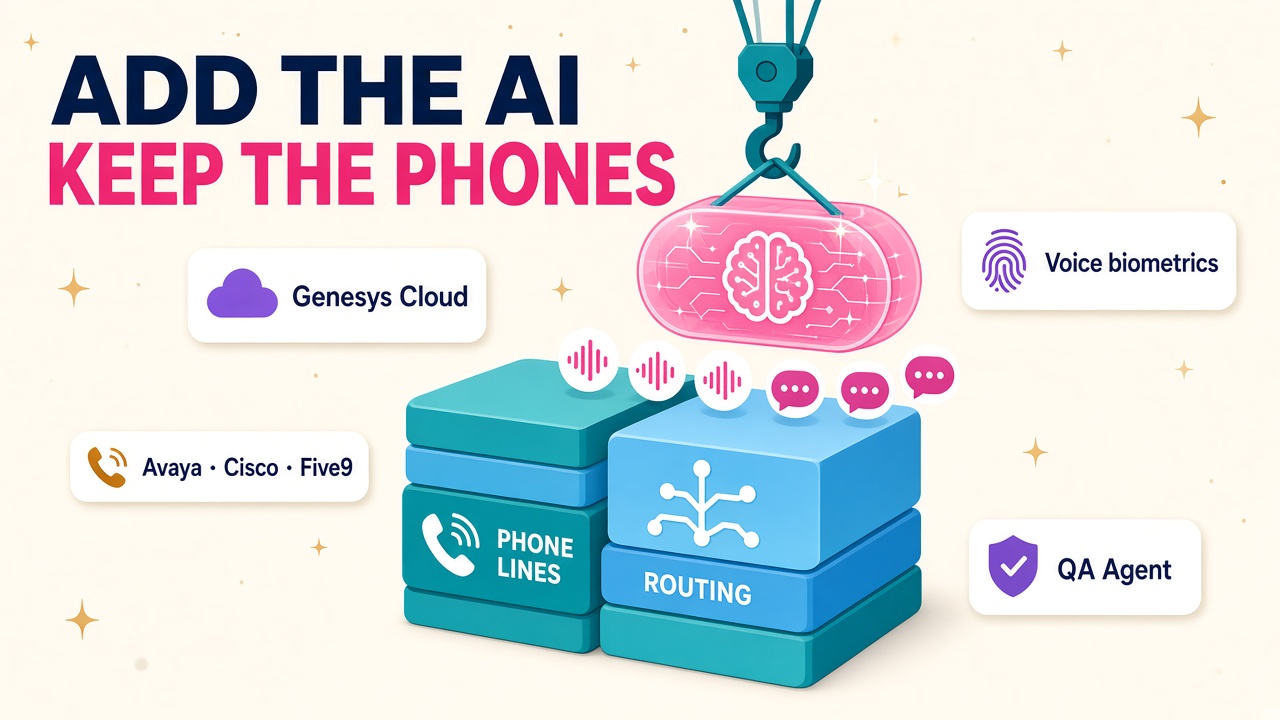
Microsoft Contact Center Intelligence is GA, adding AI agents to Genesys, Avaya, Cisco and Five9. Here are the skills D365 pros need to win this new work.
Microsoft has finally said out loud what most service leaders already knew: almost nobody is ripping out their contact centre platform this year. On 18 November at Ignite 2026, Microsoft Contact Center Intelligence (CCI) went generally available, and the whole pitch is "keep the phones you have, add our AI on top".
For anyone working in Dynamics 365 Customer Service, Contact Center or Copilot Studio, this is a big deal. It opens up a market that used to be off limits to us: every organisation running Genesys, Avaya, Cisco or Five9 that was never going to migrate to Dynamics 365 Contact Center. That is a lot of organisations, and a lot of new work.
What exactly went GA?
Contact Center Intelligence is a layer of Microsoft voice and digital AI agents that sits over the contact centre as a service (CCaaS) platform a business already runs. The telephony stays put, the routing stays put, and the human representatives keep working in the desktop they know.
According to Microsoft's November release notes, the GA scope covers:
- Contact centre integrations through native connectors, APIs, event streams and embedded experiences, with initial guidance for Genesys Cloud and a universal connector for other platforms.
- Quality and operational insights, including Quality Assurance on interactions, real-time monitoring and historical dashboards.
- Biometric authentication, using voice biometrics to identify and authenticate customers, capture consent and manage authentication data.
- Microsoft platform integration, so you can reuse agents built in Copilot Studio and extend them with Foundry.
Alongside GA, Microsoft announced joint partnerships with Avaya, Cisco and Five9 to build and maintain out-of-the-box connectors. CCI went into public preview only in October 2026, so this has moved quickly.
Why this matters more than another feature drop
I have watched plenty of "rip and replace" pitches come and go over the years. They make sense on a slide and then hit the wall of a five-year telephony contract, a nervous operations director and a migration budget that nobody wants to sign off.
CCI flips that. As CX Today put it, "You keep the platform you already run. Microsoft brings the brains." That changes who can buy Microsoft's service AI, and therefore who needs people who know how to deploy it.
It also lands on the same week Dynamics 365 moved into Copilot. The Sales and Customer Service plugins are now generally available in Copilot with more than 57 business skills, and 13 of those are service skills that triage cases, pull case history, research knowledge, draft replies and build escalation summaries. Put CCI on the front line and the Customer Service plugin behind the human representative, and you have a full AI-assisted service journey that Microsoft people can design end to end.
Competition is heating up too, which is healthy. On the same morning, Genesys launched Standalone AI Agents, letting organisations deploy its own virtual agent without first moving to Genesys Cloud. Two big vendors are now chasing the same idea: add AI agents without the migration. Whichever way a client goes, the people who understand both sides of that conversation are going to be very busy.
The skills that make you valuable on a CCI project
So what does a good CCI consultant actually need to know? Reading the GA announcement closely, I would focus on six areas.
1. Multi-agent design
CCI is built around a conversational agent builder that orchestrates a team of specialist sub-agents, each with its own knowledge and tools. You can even bring in a custom agent coded in Foundry and add it to the team "with just a few clicks".
This is a design skill as much as a technical one. Someone has to decide which intents go to which specialist, where the handoffs sit and when a human gets involved. If you have built Copilot Studio agents, you are already halfway there.
2. Knowing when to be deterministic
Microsoft has been clear that you can either give an agent general instructions and let the model use its judgement, or build turn-by-turn dialogs for jobs that must be predictable, such as complex IVR trees. Getting that balance right is where a lot of projects will succeed or fail. Regulated industries, payments and identity checks will want tight scripts. Simple "where is my order" queries can be far looser.
3. Voice configuration
Voice is a craft of its own. CCI lets you configure voice fonts (including Microsoft AI voices), speech instructions for tone and speaking style, DTMF behaviour, speech sensitivity and latency messaging that keeps callers informed while the agent completes an action. Microsoft is also bringing Microsoft AI Realtime 1, its first speech-to-speech model, to CCI, and says it leads on performance and price across external benchmarks.
If you have ever tuned an IVR, you know how much the small things matter. A two-second silence feels like a dropped call. This is a great niche for anyone with a telephony background who wants to move into AI.
4. Grounding agents in business context
Each CCI agent natively uses Microsoft IQ. Work IQ pulls from Microsoft 365, so an agent resolving a billing dispute could reference a refund policy stored in SharePoint. Foundry IQ handles large knowledge sources such as product manuals and warranty terms indexed in Azure AI Search, and Fabric IQ reasons over business data.
The practical skill here is knowledge hygiene. An agent is only as good as the documents it reads, and most organisations' knowledge bases are a long way from tidy. Consultants who can audit, clean and structure knowledge sources will earn their keep.
5. Voice biometrics and consent
Authentication is one of the most painful parts of a service call. CCI validates a caller's identity with a voiceprint while they explain why they are calling, and if a call drops, the conversation can authenticate and resume when they ring back. That is a lovely customer experience, but it involves biometric data, consent capture and data management. In the UK, EU and Australia, that means privacy impact assessments and careful configuration. Anyone who can pair the technical setup with the compliance conversation will be in demand.
6. Quality assurance and governance
CCI includes a built-in Quality Assurance Agent that maps, scores and summarises every interaction, with suggestions to improve. On the governance side, every agent built in CCI appears in the Agent 365 registry in the Microsoft 365 admin center the moment a maker names it, before it is even published. Admins can see who owns it, its channels, its Entra ID, its knowledge sources and tools, and what permissions those tools were granted.
That is exactly the kind of visibility security teams have been asking for. Learn your way around the Agent 365 registry now, because it is quickly becoming the control tower for every Microsoft agent in an organisation.
Who should be paying attention?
A few groups stand out to me.
- Dynamics 365 Customer Service and Contact Center consultants. Your skills now apply to clients on other platforms. Your addressable market just widened overnight.
- Copilot Studio makers. CCI can reuse Copilot Studio agents, so your agent-building experience carries straight over.
- Telephony and CCaaS specialists. If you know Genesys, Avaya, Cisco or Five9, learning CCI makes you the bridge every project needs.
- Partners and practice leads. Microsoft says moving to Dynamics 365 Contact Center later is an upgrade path. Landing CCI first is a sensible, lower-risk way into a client.
- Service operations and QA leads. The QA Agent and dashboards change what a quality team does all day. Less sampling of 2% of calls, more coaching based on all of them.
Will this cost contact centre jobs?
I will be honest. AI agents handling self-service will reduce the volume of simple calls that reach people. That has been happening for years, and CCI will speed it up.
But I am glass-half-full on this one, and I think the evidence backs it up. Every one of these deployments needs designers, builders, voice specialists, knowledge managers, compliance experts and QA leads. The human representatives who remain will be handling the interesting, complex and emotional calls, with full context handed over from the agent, rather than resetting passwords all day. For D365 professionals specifically, this is a net gain: more clients, more projects and more ways to add value.
How to get hands-on this month
You do not need a client project to start learning. Here is what I would do:
- Read the CCI documentation and what's new page end to end. It is short and it tells you exactly what is GA.
- Watch the Ignite session "Modernize your contact center without rip and replace" on demand.
- Build a simple two-agent team in Copilot Studio: one for order status, one for returns, with a clear handoff to a human. Then think about how it would behave on a voice channel.
- Pick one CCaaS platform you have touched before and learn how its routing and agent desktop work. The handoff is where projects get messy.
- Get comfortable with the Agent 365 registry in the Microsoft 365 admin center, so you can answer the security team's first question on day one.
- Brush up on the privacy rules for biometric data in your country.
- Write up what you learn on LinkedIn. Clients and recruiters are searching for CCI experience right now, and very few people have it yet.
What to do next
Contact Center Intelligence is a genuinely new kind of D365 work, and it is early. If you want to be one of the first names clients think of, start building now.
- Browse the latest Dynamics 365 jobs and look for Customer Service, Contact Center and Copilot Studio roles.
- Check what service and AI skills are paying on our salary guide.
- If you are a consultant with contact centre experience, add CCI to your profile on D365 consultants so the right employers can find you.
- Explore Dynamics 365 add-ons and partners on our products and vendors pages.
It is a great time to be in Microsoft service. The phones are staying, the AI is arriving and the people who can join the two are going to have a very good 2027.